
Milan · Getting around
How do you get around Milan, and what's the best way in from the airport?
August 13, 2026 · last updated · about 3 min read
Getting Around Milan
Milan's five metro lines (M1 red, M2 green, M3 yellow, M4 blue, M5 lilac) give the city the best rail coverage in Italy, and most sightseeing, shopping, and business districts sit within a short walk of a station. Trams fill in the gaps the metro misses, especially for short hops through the historic center, while buses cover outer neighborhoods. Walking works well inside the Cerchia dei Navigli ring, but the metro wins for anything beyond that.
Hubs to know
Duomo (M1/M3) sits at the city's core, and Milano Centrale (M2/M3, plus mainline trains) is the arrival point for most rail travel. Staying near either keeps transfers simple.
Tickets and passes
ATM's standard ticket covers 90 minutes across metro, tram, and bus, with day and multi-day passes aimed at travelers making several trips daily. A pass isn't worth it for a short visit with only one or two rides a day — single tickets are simpler to track.
Airport transfers
Malpensa (MXP): the Malpensa Express train runs to Centrale or Cadorna and stays reliable regardless of traffic; a shuttle bus to Centrale costs less but takes longer; taxis are fastest door-to-door but the priciest option.
Linate (LIN): the M4 metro line runs directly into the center (San Babila, Duomo), making it the simplest option for most travelers; taxis remain a quick alternative for short direct trips.
Practical notes
Rush hour runs roughly 8-9:30am and 5:30-7:30pm, when M1 and M2 get crowded — avoid these windows with heavy luggage. Metro service generally winds down shortly after midnight, later on weekends, so plan late returns around trams or buses. M4 and M5 stations were built with step-free access; older M1 stations are less consistent, so check ahead if mobility access matters.
Pick your dates — we'll search Milan hotels for you
Choose dates and guests, and the buttons below will open search results with your criteria. Prices differ between sites, so compare before you book.
 View on Booking.com
 View on Hotels.com
Things to see in Milan
See all →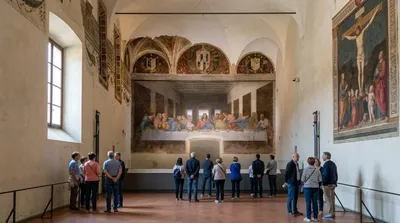
Heritage & monuments
The Last Supper
The Last Supper is a mural painted by Leonardo da Vinci around 1495–1498, still in its original location on the wall of the refectory at Santa Maria delle Grazie. It captures the moment just after Jesus tells his twelve apostles at their final meal, "One of you will betray me," and is renowned for its use of perspective and its vivid depiction of each figure's expression and gesture.
Temples & religious sites
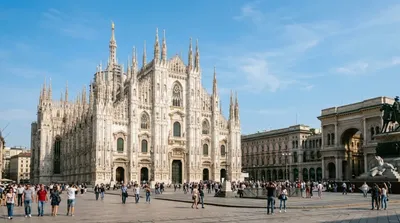
Milan Cathedral
Milan Cathedral (the Duomo) is a Roman Catholic cathedral dedicated to the Nativity of the Virgin Mary and the seat of the Archdiocese of Milan. Many visitors come to see its facade, covered in ornate spires and statues, and its stained-glass-filled interior firsthand. Climbing to the rooftop terrace offers a close-up view of the spires, and on clear days, panoramic views of the city as well.
Culture & venues
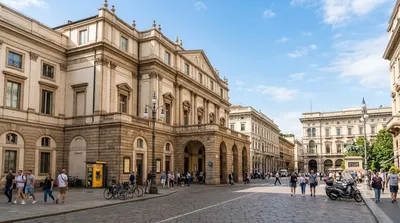
La Scala
La Scala is a historic opera house in Milan that opened on August 3, 1778, originally under the name "Nuovo Regio Ducale Teatro alla Scala." Its opening performance was Antonio Salieri's "Europa riconosciuta." Still an active venue for opera, ballet, and classical concerts today, it's worth a visit simply to see its opulent auditorium and stage in person.
Temples & religious sites
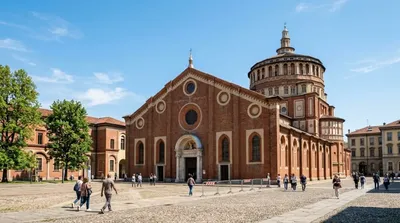
Santa Maria delle Grazie
Santa Maria delle Grazie is a Dominican church and convent in Milan, designated a UNESCO World Heritage Site. Most visitors come to see Leonardo da Vinci's Last Supper mural, painted on the wall of the convent's refectory (Cenacolo).
More Milan guides
Best value
Where to stay in Milan for the best value near the metro
5-star & luxury
Where to Stay in Milan for a 5-Star or Luxury Hotel
Pool villas & resorts
Where to Stay in Milan for Pool Villas and Resort-Style Hotels
Family travel
Where to Stay in Milan with Kids: Neighborhoods by Metro Line
Couples & honeymoon
Where to stay in Milan for couples and honeymoons
Central & near stations
Where should I stay in Milan to be close to the metro and train stations?
Best time to visit
When Is the Best Time to Visit Milan for Weather, Crowds, and Prices?
First-time guide
How should first-time visitors get around and explore Milan?
Getting around guides for other destinations
Guantánamo
How to Get Around Guantánamo and Travel from Antonio Maceo Airport
Cetinje
How to Get Around Cetinje and Travel from Podgorica Airport
North Nicosia
How to get around North Nicosia and travel from Larnaca Airport
Cienfuegos
How to get around Cienfuegos: transport options and airport transfers