
 Italy
Italy
Milan
Fashion and design, and Italy's northern rail gateway. The metro is good, so staying near a station keeps things simple.
Updated August 15, 2026 · Edited by the World by City editors
- Gateway airport
- Malpensa (MXP) & Linate (LIN)
- Best season
- Apr–Jun, Sep–Oct
- Time zone
- Europe/Rome
- Sights covered
- 40 places
Sights worth seeing
See all 40 →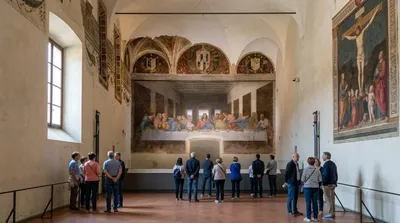
Heritage & monuments
The Last Supper
The Last Supper is a mural painted by Leonardo da Vinci around 1495–1498, still in its original location on the wall of the refectory at Santa Maria delle Grazie. It captures the moment just after Jesus tells his twelve apostles at their final meal, "One of you will betray me," and is renowned for its use of perspective and its vivid depiction of each figure's expression and gesture.
Temples & religious sites
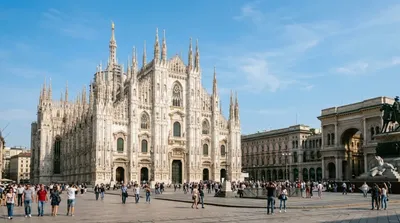
Milan Cathedral
Milan Cathedral (the Duomo) is a Roman Catholic cathedral dedicated to the Nativity of the Virgin Mary and the seat of the Archdiocese of Milan. Many visitors come to see its facade, covered in ornate spires and statues, and its stained-glass-filled interior firsthand. Climbing to the rooftop terrace offers a close-up view of the spires, and on clear days, panoramic views of the city as well.
Culture & venues
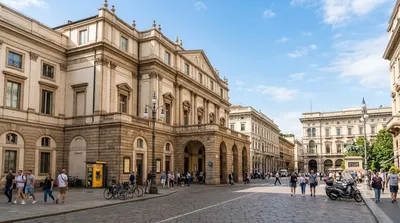
La Scala
La Scala is a historic opera house in Milan that opened on August 3, 1778, originally under the name "Nuovo Regio Ducale Teatro alla Scala." Its opening performance was Antonio Salieri's "Europa riconosciuta." Still an active venue for opera, ballet, and classical concerts today, it's worth a visit simply to see its opulent auditorium and stage in person.
Temples & religious sites
Santa Maria delle Grazie
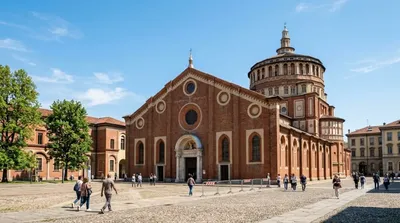
Santa Maria delle Grazie is a Dominican church and convent in Milan, designated a UNESCO World Heritage Site. Most visitors come to see Leonardo da Vinci's Last Supper mural, painted on the wall of the convent's refectory (Cenacolo).
Castles & palaces
Sforza Castle
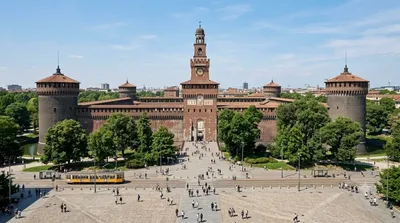
Castello Sforzesco was built in the 15th century by Duke Francesco Sforza of Milan on the site of a 14th-century fortress, later expanded into one of the largest citadels in Europe. It took its present form after a major restoration by Luca Beltrami in the late 19th and early 20th centuries, and today it houses several museums and art collections.
Museums & galleries
Galleria Vittorio Emanuele II
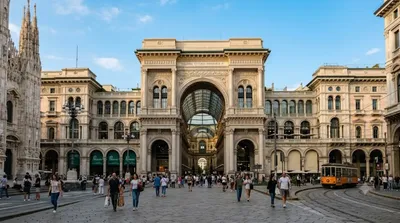
Located right next to Milan Cathedral's square, this glass-roofed arcade is Italy's oldest shopping gallery still in operation today. Four-story buildings line its cross-shaped passages, distinguished by a steel-and-glass domed roof and mosaic-decorated floors.
Museums & galleries
Pinacoteca di Brera
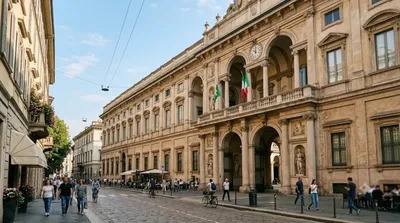
The Pinacoteca di Brera is Milan's leading painting museum, holding a collection of Italian paintings spanning the 13th to 20th centuries. Housed in the Palazzo di Brera, which it shares with the Brera Academy, it brings together religious paintings gathered from across Italy alongside works by Renaissance masters, making it an excellent place to trace the development of Italian art history.
Views & landmarks
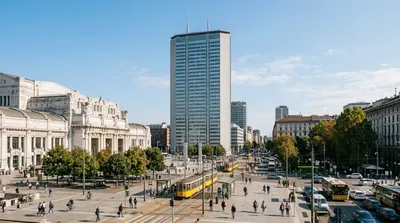
Pirelli Tower
The Pirelli Tower is one of Milan's landmark skyscrapers, standing 32 stories and 127 meters tall. Its distinctive narrow, elongated floor plan means the building's appearance changes dramatically depending on the angle from which it's viewed.
How many days do you need?
Routes grouped by travel distance so each day stays comfortable.
Average temperature by month
5-year average
Getting there
Check flights to Milan first
Pick a departure airport and date to jump straight to results for Malpensa (MXP) & Linate (LIN).
Check fares and seat availability on the flight search site.
Getting around the city
What you will actually use to get around Milan, and whether you need a car.
- Metro & rail
- Four lines — the best metro coverage in Italy. The Duomo and Centrale are the hubs, so staying near a station is convenient.
- Buses & trams
- Trams are part of the cityscape and take the same ticket as the metro.
- Transit cards & payment
- ATM tickets, valid on the metro, trams and buses alike.
- Airport to city
- Malpensa connects to Centrale by the Malpensa Express or bus. Linate is close in, a short metro or bus ride away.
- Car rental
- Milan has the Area C congestion zone, so entering the centre costs. Public transport is better in town; consider a car for Lake Como and other trips.
Book transport
Fares and timetables change often, so we don't list them here. Check the operator or the booking site for current prices and schedules.
Getting to other cities
Useful when you're combining several cities. Times are approximate; fares and timetables change often, so we don't list them.
Transit options connecting Venice and Milan.
- Train · approx. 2 hrs 30 mins Convenient transit between the two cities. Please check official booking sites for current schedules.
- Car / Drive · approx. 3 hrs Convenient transit between the two cities. Please check official booking sites for current schedules.
- Bus · approx. 3~4 hrs Convenient transit between the two cities. Please check official booking sites for current schedules.
Transit options connecting Florence and Milan.
- Train · approx. 1 hrs 40 mins~2 hrs Convenient transit between the two cities. Please check official booking sites for current schedules.
- Bus · approx. 3~4 hrs Convenient transit between the two cities. Please check official booking sites for current schedules.
- Car / Drive · approx. 3 hrs Convenient transit between the two cities. Please check official booking sites for current schedules.
- Flight · approx. 1 hrs 15 mins (flight time) Convenient transit between the two cities. Please check official booking sites for current schedules.
Transit options connecting Milan and Dolomites.
- Car / Drive · approx. 4~5 hrs Convenient transit between the two cities. Please check official booking sites for current schedules.
- Train + Bus · approx. 5~7 hrs Convenient transit between the two cities. Please check official booking sites for current schedules.
- Bus · approx. 5~6 hrs Convenient transit between the two cities. Please check official booking sites for current schedules.
Transit options connecting Rome and Milan.
- Train · approx. 3 hrs Convenient transit between the two cities. Please check official booking sites for current schedules.
- Flight · flight approx. approx. 1 hrs 15 mins, incl. airport transfer approx. 3~4 hrs Convenient transit between the two cities. Please check official booking sites for current schedules.
- Bus · approx. 7~8 hrs Convenient transit between the two cities. Please check official booking sites for current schedules.
- Car / Drive · approx. 6 hrs Convenient transit between the two cities. Please check official booking sites for current schedules.
Transit options connecting Milan and Naples.
- Flight · approx. 1 hrs 15 mins (excl. airport transfer/check-in) Convenient transit between the two cities. Please check official booking sites for current schedules.
- High-Speed Train · approx. 5 hrs 30 mins to 7 hrs Convenient transit between the two cities. Please check official booking sites for current schedules.
- Bus · approx. 10 hrs or more Convenient transit between the two cities. Please check official booking sites for current schedules.
- Car / Drive · approx. 7 hrs to 8 hrs Convenient transit between the two cities. Please check official booking sites for current schedules.
Milan Tours & Experiences Booking
Book local tours, tickets, and experiences in advance to enjoy without waiting. Check available products and prices now.
 GetYourGuide
 Klook
Klook
 Tiqets
 KKday
KKday
 WeGoTrip
Check prices and availability on the booking sites.
 Airalo
 Yesim
Yesim
 Saily
Saily
 Drimsim
Where to stay
See all stays →Pick your dates — we'll search Milan hotels for you
Choose dates and guests, and the buttons below will open search results with your criteria. Prices differ between sites, so compare before you book.
 View on Booking.com
 View on Hotels.com
Hotel membership
Staying at Accor hotels often? ALL Accor+ Explorer
A paid annual membership. It includes two free nights a year across Asia-Pacific, 30% off dining and 15% off drinks, and 15% off stays at more than 4,500 hotels worldwide.
Explore the membership
Visit stories: Milan
Have you been to this city?
Share your visit story with photos you took yourself. Once checked, it goes into the Magazine.
Guides by theme
Best value
Where to stay in Milan for the best value near the metro
Read guide →
5-star & luxury
Where to Stay in Milan for a 5-Star or Luxury Hotel
Read guide →
Pool villas & resorts
Where to Stay in Milan for Pool Villas and Resort-Style Hotels
Read guide →
Family travel
Where to Stay in Milan with Kids: Neighborhoods by Metro Line
Read guide →
Couples & honeymoon
Where to stay in Milan for couples and honeymoons
Read guide →
Central & near stations
Where should I stay in Milan to be close to the metro and train stations?
Read guide →
Best time to visit
When Is the Best Time to Visit Milan for Weather, Crowds, and Prices?
Read guide →
First-time guide
How should first-time visitors get around and explore Milan?
Read guide →
Getting around
How do you get around Milan, and what's the best way in from the airport?
Read guide →