
 Italy
Italy
Florence
Renaissance art concentrated in one place. The centre is small enough to walk, and it works as a base for day trips across Tuscany.
Updated August 15, 2026 · Edited by the World by City editors
- Gateway airport
- Florence (FLR) & Pisa (PSA)
- Best season
- Apr–Jun, Sep–Oct
- Time zone
- Europe/Rome
- Sights covered
- 40 places
Sights worth seeing
See all 40 →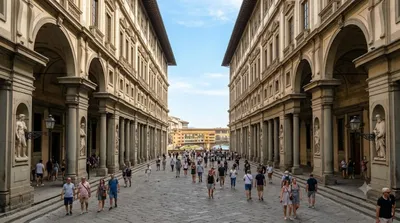
Museums & galleries
Uffizi Gallery
The Uffizi Gallery, located near Piazza della Signoria in Florence, is renowned for its collection of Italian Renaissance paintings. With works by Botticelli, Leonardo da Vinci, Michelangelo, and Raphael all under one roof, it's an ideal stop for travelers wanting to trace the development of Renaissance art firsthand.
Museums & galleries
Florence Cathedral
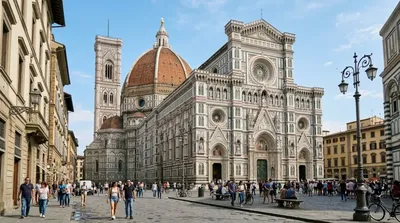
Florence Cathedral, or Santa Maria del Fiore, is the city's archiepiscopal cathedral, begun in 1296 to a Gothic design by Arnolfo di Cambio and completed in 1436 with Filippo Brunelleschi's dome. The exterior is faced with white marble panels alternating with green and pink marble, and the facade is a 19th-century Gothic Revival design by Emilio De Fabris.

Museums & galleries
Palazzo Pitti
The Pitti Palace is a vast Renaissance palace south of the Arno River, not far from the Ponte Vecchio. It was built in 1458 as the residence of Florentine banker Luca Pitti and was greatly enlarged after passing into the hands of the Medici family.
Views & landmarks
Ponte Vecchio
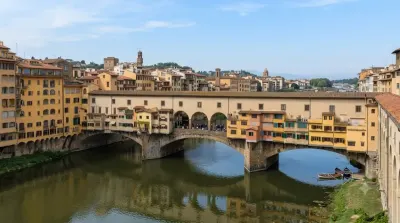
The Ponte Vecchio is a medieval stone bridge over the Arno River, distinctive for the shops lining both sides of its span. Butchers, tanners, and greengrocers once occupied the bridge, but today it houses jewelers selling gold and gems, art galleries, and souvenir shops. It was also the only bridge in Florence to survive the destruction of World War II.
Museums & galleries
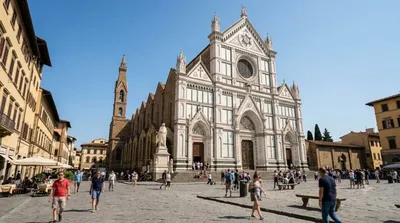
Basilica of Santa Croce
Santa Croce is Florence's principal Franciscan basilica, standing on Piazza Santa Croce about 800 meters southeast of the Duomo. It was built on what was once marshland outside the city walls.
Temples & religious sites
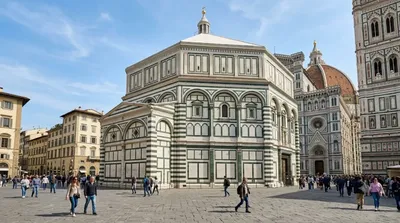
Florence Baptistery
Also known as the Baptistery of San Giovanni, this octagonal building is dedicated to Florence's patron saint, John the Baptist, and stands between Piazza del Duomo and Piazza San Giovanni, flanked by the Cathedral and the Archbishop's Palace. Visitors come for the relief-carved bronze doors and the mosaics covering the interior ceiling, and together with the Cathedral it has long been a center of the city's religious life.
Museums & galleries
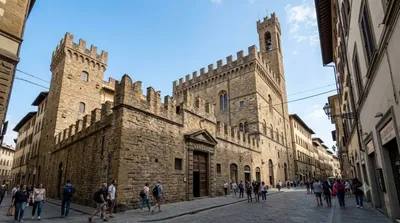
Bargello National Museum
The Bargello Palace, built in the 13th century, is one of Florence's oldest public buildings, once serving as a government seat, police headquarters, and prison. Since 1865 it has operated as a national museum, showcasing a collection centered on Renaissance sculpture.
Museums & galleries
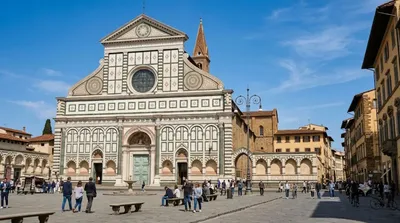
Basilica of Santa Maria Novella
Santa Maria Novella is a Dominican church in Florence, regarded as one of the most important Romanesque-Gothic buildings in Tuscany and designated a UNESCO World Heritage site. Construction began in 1290 and took about 200 years to complete, with the church consecrated in 1420.
How many days do you need?
Routes grouped by travel distance so each day stays comfortable.
Average temperature by month
5-year average
Getting there
Check flights to Florence first
Pick a departure airport and date to jump straight to results for Florence (FLR) & Pisa (PSA).
Check fares and seat availability on the flight search site.
Getting around the city
What you will actually use to get around Florence, and whether you need a car.
- Metro & rail
- No metro. The centre is small enough to walk.
- Buses & trams
- Trams (T1, T2) and buses connect the outskirts and the airport. Around the Duomo, walking is fastest.
- Transit cards & payment
- ATAF bus and tram tickets — validate when boarding.
- Airport to city
- Tram T2 links Florence Airport to the city. Via Pisa Airport, it is the PisaMover plus a train.
- Car rental
- Florence also has a wide ZTL, so driving in the centre risks fines. Renting outside the centre for Tuscan day trips is the safer approach.
Book transport
Fares and timetables change often, so we don't list them here. Check the operator or the booking site for current prices and schedules.
Getting to other cities
Useful when you're combining several cities. Times are approximate; fares and timetables change often, so we don't list them.
Transit options connecting Venice and Florence.
- Train · approx. 2 hrs Convenient transit between the two cities. Please check official booking sites for current schedules.
- Car / Drive · approx. 2 hrs 30 mins Convenient transit between the two cities. Please check official booking sites for current schedules.
- Bus · approx. 3 hrs Convenient transit between the two cities. Please check official booking sites for current schedules.
Transit options connecting Rome and Florence.
- Train · approx. 1 hrs 30 mins Convenient transit between the two cities. Please check official booking sites for current schedules.
- Bus · approx. 3 hrs to 3 hrs 30 mins Convenient transit between the two cities. Please check official booking sites for current schedules.
- Car / Drive · approx. 3 hrs Convenient transit between the two cities. Please check official booking sites for current schedules.
Transit options connecting Florence and Milan.
- Train · approx. 1 hrs 40 mins~2 hrs Convenient transit between the two cities. Please check official booking sites for current schedules.
- Bus · approx. 3~4 hrs Convenient transit between the two cities. Please check official booking sites for current schedules.
- Car / Drive · approx. 3 hrs Convenient transit between the two cities. Please check official booking sites for current schedules.
- Flight · approx. 1 hrs 15 mins (flight time) Convenient transit between the two cities. Please check official booking sites for current schedules.
Transit options connecting Florence and Dolomites.
- Car / Drive · approx. 4~5 hrs Convenient transit between the two cities. Please check official booking sites for current schedules.
- Train + Bus · approx. 5~6 hrs Convenient transit between the two cities. Please check official booking sites for current schedules.
- Flight + 육상 이동 · approx. 5~7 hrs (환승 포함) Convenient transit between the two cities. Please check official booking sites for current schedules.
Transit options connecting Florence and Naples.
- Train · approx. 3 hrs Convenient transit between the two cities. Please check official booking sites for current schedules.
- Car / Drive · approx. 4 hrs Convenient transit between the two cities. Please check official booking sites for current schedules.
- Bus · approx. 5~6 hrs Convenient transit between the two cities. Please check official booking sites for current schedules.
- Flight · approx. 3~4 hrs(공항 이동·대기 포함) Convenient transit between the two cities. Please check official booking sites for current schedules.
Florence Tours & Experiences Booking
Book local tours, tickets, and experiences in advance to enjoy without waiting. Check available products and prices now.
 GetYourGuide
 Klook
Klook
 Tiqets
 KKday
KKday
 WeGoTrip
Check prices and availability on the booking sites.
 Airalo
 Yesim
Yesim
 Saily
Saily
 Drimsim
Where to stay
See all stays →Pick your dates — we'll search Florence hotels for you
Choose dates and guests, and the buttons below will open search results with your criteria. Prices differ between sites, so compare before you book.
 View on Booking.com
 View on Hotels.com
Hotel membership
Staying at Accor hotels often? ALL Accor+ Explorer
A paid annual membership. It includes two free nights a year across Asia-Pacific, 30% off dining and 15% off drinks, and 15% off stays at more than 4,500 hotels worldwide.
Explore the membership
Visit stories: Florence
Have you been to this city?
Share your visit story with photos you took yourself. Once checked, it goes into the Magazine.
Guides by theme
Best value
Where should I stay in Florence for the best value?
Read guide →
5-star & luxury
Which area of Florence is best for a 5-star or luxury hotel stay?
Read guide →
Pool villas & resorts
Where to Stay in Florence for a Pool Villa or Resort
Read guide →
Family travel
Where to Stay in Florence with Kids: A Guide to Family-Friendly Neighborhoods
Read guide →
Couples & honeymoon
Where should couples stay in Florence for a honeymoon trip?
Read guide →
Central & near stations
Where to stay in Florence near Santa Maria Novella and the historic centre
Read guide →
Best time to visit
When Is the Best Time to Visit Florence?
Read guide →
First-time guide
How to plan your first trip to Florence, Italy
Read guide →
Getting around
How to get around Florence, Italy: walking, trams, and day-trip trains
Read guide →