
Florence · Best value
Where should I stay in Florence for the best value?
August 2, 2026 · last updated · about 3 min read
Where to Stay in Florence for the Best Value
The historic centre is small enough to cross on foot in under half an hour, so value here depends less on distance from the Duomo and more on which streets carry a tourist premium.
Santa Croce
East of the Duomo, mixing local life with a short walk to the Uffizi and Ponte Vecchio. Rates tend to sit below the San Giovanni core for similar proximity. Via de' Neri and Via dei Benci get loud at night, so ask about the room's exact location.
Oltrarno
South of the Arno around San Niccolo and San Frediano, Florence's artisan quarter: workshops and trattorie rather than tour groups. A 10-15 minute walk over Ponte Vecchio or Ponte alle Grazie reaches the main sights, and it's generally quieter and better value than the centre.
Near Santa Maria Novella station
Useful if day trips to Pisa, Siena, or Lucca matter, since regional trains leave from here. Streets just north and west of the station can offer value, but check reviews for noise and confirm the walk to the Duomo (about 10 minutes).
What to check before booking
- Elevator access: many historic palazzi have no lift.
- Air conditioning: not standard everywhere, relevant June-August.
- Exact street: check the address on a map rather than trust a "city centre" label; Santa Croce and San Lorenzo both have quiet and noisy pockets.
- Breakfast and city tax: confirm what's included, as these vary independently of the nightly rate.
Transport and timing
There's no metro; the centre is walkable end to end. FLR connects to the centre and the station by tram; PSA links to the same station by direct train, so a base near the station simplifies arrival from either airport. Spring and summer bring tighter availability and higher rates; November-February, outside Christmas week, offers more room for value.
Pick your dates — we'll search Florence hotels for you
Choose dates and guests, and the buttons below will open search results with your criteria. Prices differ between sites, so compare before you book.
 View on Booking.com
 View on Hotels.com
Things to see in Florence
See all →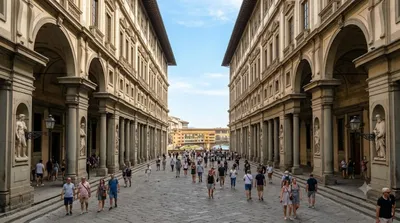
Museums & galleries
Uffizi Gallery
The Uffizi Gallery, located near Piazza della Signoria in Florence, is renowned for its collection of Italian Renaissance paintings. With works by Botticelli, Leonardo da Vinci, Michelangelo, and Raphael all under one roof, it's an ideal stop for travelers wanting to trace the development of Renaissance art firsthand.
Museums & galleries
Florence Cathedral
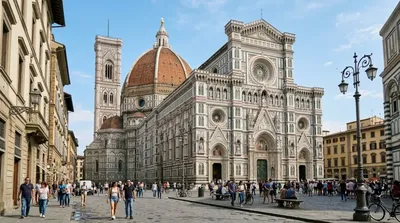
Florence Cathedral, or Santa Maria del Fiore, is the city's archiepiscopal cathedral, begun in 1296 to a Gothic design by Arnolfo di Cambio and completed in 1436 with Filippo Brunelleschi's dome. The exterior is faced with white marble panels alternating with green and pink marble, and the facade is a 19th-century Gothic Revival design by Emilio De Fabris.

Museums & galleries
Palazzo Pitti
The Pitti Palace is a vast Renaissance palace south of the Arno River, not far from the Ponte Vecchio. It was built in 1458 as the residence of Florentine banker Luca Pitti and was greatly enlarged after passing into the hands of the Medici family.
Views & landmarks
Ponte Vecchio
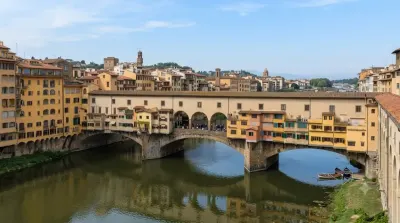
The Ponte Vecchio is a medieval stone bridge over the Arno River, distinctive for the shops lining both sides of its span. Butchers, tanners, and greengrocers once occupied the bridge, but today it houses jewelers selling gold and gems, art galleries, and souvenir shops. It was also the only bridge in Florence to survive the destruction of World War II.
More Florence guides
5-star & luxury
Which area of Florence is best for a 5-star or luxury hotel stay?
Pool villas & resorts
Where to Stay in Florence for a Pool Villa or Resort
Family travel
Where to Stay in Florence with Kids: A Guide to Family-Friendly Neighborhoods
Couples & honeymoon
Where should couples stay in Florence for a honeymoon trip?
Central & near stations
Where to stay in Florence near Santa Maria Novella and the historic centre
Best time to visit
When Is the Best Time to Visit Florence?
First-time guide
How to plan your first trip to Florence, Italy
Getting around
How to get around Florence, Italy: walking, trams, and day-trip trains