
 Italy
Italy
Naples
The home of pizza and the jumping-off point for Pompeii and the Amalfi Coast. Lively, and worth keeping an eye on your belongings.
Updated August 15, 2026 · Edited by the World by City editors

- Gateway airport
- Naples Capodichino (NAP)
- Best season
- Apr–Jun, Sep–Oct
- Time zone
- Europe/Rome
- Sights covered
- 40 places
Sights worth seeing
See all 40 →
Nature
Phlegraean Fields
The Phlegraean Fields are a vast volcanic caldera west of Naples, so close to the city that part of Naples itself sits atop it. The terrain, shaped by volcanic activity, is dotted with fumaroles and other signs of geothermal activity, and the area is often described in the media as a "supervolcano."

Culture & venues
Teatro di San Carlo
The Teatro di San Carlo, next to the Royal Palace of Naples, is an opera house that opened in 1737 and is known as the world's oldest continuously operating opera house. Having been built before Milan's La Scala and Venice's La Fenice, it offers a firsthand look at the history of Italian opera.

Museums & galleries
Naples National Archaeological Museum
The National Archaeological Museum of Naples is one of Italy's leading archaeological museums, holding artifacts from the Greek, Roman, and Renaissance periods. Its core collection centers on Roman-era finds excavated from nearby Pompeii, Stabiae, and Herculaneum, and it's especially known for its mosaics and sculptures. From 1816 to 1861, it was known as the "Royal Bourbon Museum."

Museums & galleries
Museo di Capodimonte
The Capodimonte Museum is a national art museum housed in the Royal Palace of Capodimonte, built by the Bourbon dynasty in the 18th century. It grew out of the Farnese family's collection and the royal holdings of the Kingdom of Naples, and is considered to hold the richest collection of Neapolitan school paintings and decorative arts.

Castles & palaces
Castel Nuovo
Castel Nuovo is a medieval castle facing Naples's city hall square, often called "Maschio Angioino." First built in 1279, it served as a residence for the Neapolitan, Aragonese, and Spanish royal houses until 1815. Its signature feature is the white marble triumphal arch set between five round towers, offering a tangible look at the long history of rule over the port city of Naples.

Temples & religious sites
Naples Cathedral
Naples Cathedral is a Roman Catholic church dedicated to the Assumption of the Virgin Mary, serving as the seat of the Archdiocese of Naples and its archbishop. It is best known for its chapel honoring Naples' patron saint, San Gennaro, and is commonly called the Duomo by locals. Walking through its interior and chapels, which layer architectural styles from different eras, gives a real sense of the city's spiritual center.

Museums & galleries
Royal Palace of Naples
The Royal Palace of Naples stands on Piazza del Plebiscito in the historic center, once serving as the residence of Naples' rulers, including the Bourbon dynasty. Its main entrance faces the piazza, but the grounds extend with further entrances toward Piazza Trieste e Trento, Piazza Municipio, and Via Acton, forming a large complex that also includes gardens and the Teatro di San Carlo.
Nature
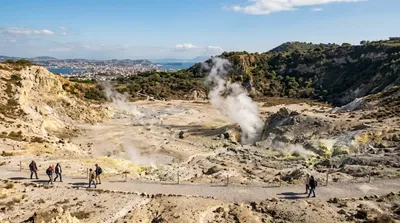
Solfatara
Solfatara is a shallow volcanic crater in Pozzuoli, near Naples, part of the Campi Flegrei (Phlegraean Fields) volcanic area. It formed about 4,000 years ago, with its last recorded eruption in 1198, thought to have been a phreatic explosion caused by groundwater meeting magma.
How many days do you need?
Routes grouped by travel distance so each day stays comfortable.
Average temperature by month
5-year average
Getting there
Check flights to Naples first
Pick a departure airport and date to jump straight to results for Naples Capodichino (NAP).
Check fares and seat availability on the flight search site.
Getting around the city
What you will actually use to get around Naples, and whether you need a car.
- Metro & rail
- Lines 1 and 2. Several Line 1 stations are decorated as art installations and are worth seeing in themselves. On these hills the funiculars are part of the transit system.
- Buses & trams
- Bus frequency is uneven. For Pompeii and Sorrento, the Circumvesuviana regional railway is the main route.
- Transit cards & payment
- ANM tickets, shared across the metro, buses and funiculars.
- Airport to city
- Capodichino is close to the city, with the Alibus linking the central station and the port.
- Car rental
- Driving in Naples is demanding if you are not used to the traffic. The Amalfi Coast road is narrow and jams in peak season, so trains, ferries or a car with a driver are the practical alternatives.
Book transport
Fares and timetables change often, so we don't list them here. Check the operator or the booking site for current prices and schedules.
Getting to other cities
Useful when you're combining several cities. Times are approximate; fares and timetables change often, so we don't list them.
Transit options connecting Rome and Naples.
- High-Speed Train · approx. 1 hrs 10 mins~1 hrs 20 mins Convenient transit between the two cities. Please check official booking sites for current schedules.
- Express Bus · approx. 2 hrs 30 mins~3 hrs Convenient transit between the two cities. Please check official booking sites for current schedules.
- Car / Drive · approx. 2 hrs~2 hrs 30 mins Convenient transit between the two cities. Please check official booking sites for current schedules.
- Flight · approx. 1 hrs(flight hrs) Convenient transit between the two cities. Please check official booking sites for current schedules.
Transit options connecting Florence and Naples.
- Train · approx. 3 hrs Convenient transit between the two cities. Please check official booking sites for current schedules.
- Car / Drive · approx. 4 hrs Convenient transit between the two cities. Please check official booking sites for current schedules.
- Bus · approx. 5~6 hrs Convenient transit between the two cities. Please check official booking sites for current schedules.
- Flight · approx. 3~4 hrs(공항 이동·대기 포함) Convenient transit between the two cities. Please check official booking sites for current schedules.
Transit options connecting Venice and Naples.
- Flight · flight approx. 1 hrs 20 mins, 공항 이동과 수속 포함 door-to-door approx. approx. 3~4 hrs Convenient transit between the two cities. Please check official booking sites for current schedules.
- Train · approx. 6~7 hrs Convenient transit between the two cities. Please check official booking sites for current schedules.
- Bus · approx. 10~12 hrs Convenient transit between the two cities. Please check official booking sites for current schedules.
- Car / Drive · approx. 7~8 hrs Convenient transit between the two cities. Please check official booking sites for current schedules.
Transit options connecting Naples and Dolomites.
- Flight (나폴리 → 베네치아, 이후 육로 연결) · flight approx. 1 hrs 15 mins, 돌로미티 마을 추가로 approx. 2~3 hrs Convenient transit between the two cities. Please check official booking sites for current schedules.
- Train · 전체 approx. 6~8 hrs Convenient transit between the two cities. Please check official booking sites for current schedules.
- Car / Drive · approx. 7~8 hrs Convenient transit between the two cities. Please check official booking sites for current schedules.
Transit options connecting Milan and Naples.
- Flight · approx. 1 hrs 15 mins (excl. airport transfer/check-in) Convenient transit between the two cities. Please check official booking sites for current schedules.
- High-Speed Train · approx. 5 hrs 30 mins to 7 hrs Convenient transit between the two cities. Please check official booking sites for current schedules.
- Bus · approx. 10 hrs or more Convenient transit between the two cities. Please check official booking sites for current schedules.
- Car / Drive · approx. 7 hrs to 8 hrs Convenient transit between the two cities. Please check official booking sites for current schedules.
Naples Tours & Experiences Booking
Book local tours, tickets, and experiences in advance to enjoy without waiting. Check available products and prices now.
 GetYourGuide
 Klook
Klook
 Tiqets
 KKday
KKday
 WeGoTrip
Check prices and availability on the booking sites.
 Airalo
 Yesim
Yesim
 Saily
Saily
 Drimsim
Where to stay
See all stays →Pick your dates — we'll search Naples hotels for you
Choose dates and guests, and the buttons below will open search results with your criteria. Prices differ between sites, so compare before you book.
 View on Booking.com
 View on Hotels.com
Hotel membership
Staying at Accor hotels often? ALL Accor+ Explorer
A paid annual membership. It includes two free nights a year across Asia-Pacific, 30% off dining and 15% off drinks, and 15% off stays at more than 4,500 hotels worldwide.
Explore the membership
Visit stories: Naples
Have you been to this city?
Share your visit story with photos you took yourself. Once checked, it goes into the Magazine.
Guides by theme
Best value
Where should I stay in Naples for the best value?
Read guide →
5-star & luxury
Where to stay in Naples for a 5-star or luxury hotel: waterfront, Chiaia, or Vomero, and how each connects to transport and sights.
Read guide →
Pool villas & resorts
Where should you stay near Naples for a pool villa or resort?
Read guide →
Family travel
Where should families stay in Naples?
Read guide →
Couples & honeymoon
Where should couples stay in Naples for a honeymoon trip?
Read guide →
Central & near stations
Where to Stay in Naples Near the Metro and Train Stations
Read guide →
Best time to visit
When Is the Best Time to Visit Naples, Italy?
Read guide →
First-time guide
How should a first-time visitor plan a trip to Naples, Italy?
Read guide →
Getting around
How do you get around Naples and reach Pompeii or the Amalfi Coast?
Read guide →