
 Italy
Italy
Venice
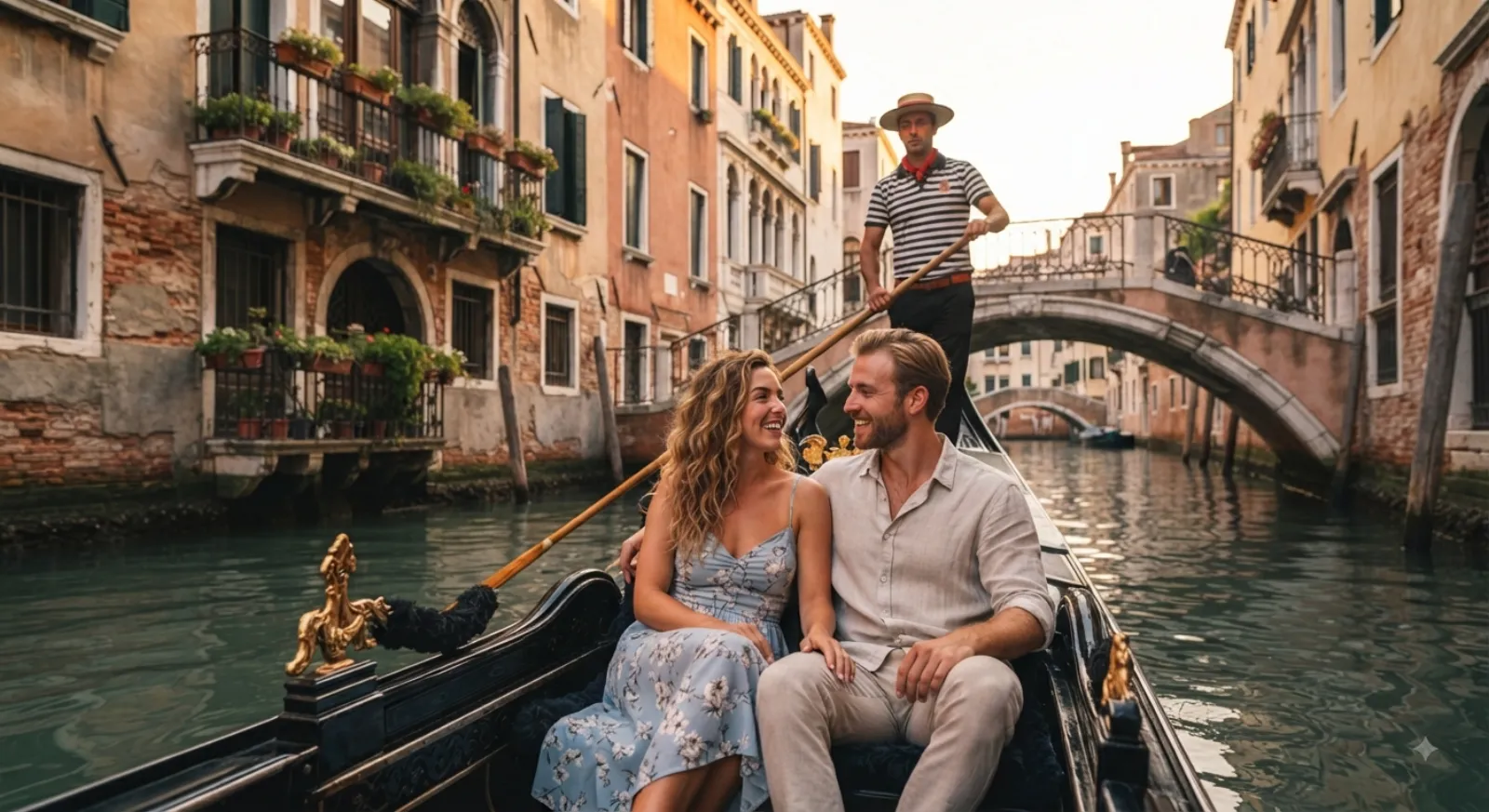
A city on water with no cars. Staying on the main island or on the mainland (Mestre) changes both your budget and your travel time considerably.
Updated August 15, 2026 · Edited by the World by City editors
- Gateway airport
- Venice Marco Polo (VCE)
- Best season
- Apr–Jun, Sep–Oct
- Time zone
- Europe/Rome
- Sights covered
- 42 places
Sights worth seeing
See all 42 →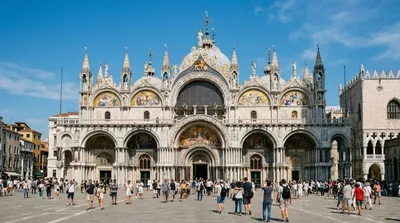
Temples & religious sites
St Mark's Basilica
St Mark's Basilica is the patriarchal cathedral of Venice, said to hold the relics of the Evangelist Mark. It became the cathedral in 1807, succeeding San Pietro di Castello, and is known for its Byzantine interior and façade covered in gold mosaics — a highlight for anyone interested in church architecture and religious art.
Museums & galleries
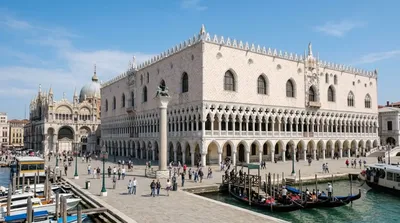
Doge's Palace
The Doge's Palace served as the residence of the Doge, the seat of government, and a prison during the Republic of Venice. Built in Venetian Gothic style, it was first constructed in 810 and rebuilt in 1340, with further additions and renovations over the following centuries. It has operated as a museum since 1923 and is one of eleven museums managed by the Fondazione Musei Civici di Venezia.
Parks & gardens
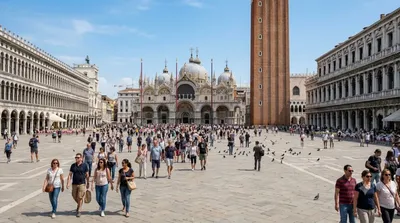
Piazza San Marco
Piazza San Marco is Venice's central square, surrounded by the city's major landmarks, including St. Mark's Basilica, its bell tower, and the Doge's Palace. The square itself is less a destination than a starting point where Venice's most iconic buildings converge, and the arcades lining it are filled with cafés and shops.
Nature
Venetian Lagoon
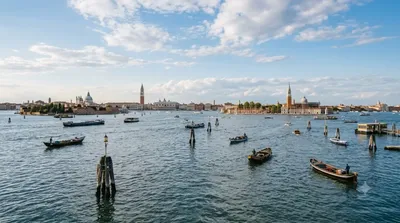
The Venetian Lagoon is a shallow bay connected to the Adriatic Sea, and the city of Venice itself is built across the many islands scattered within it. In other words, simply walking through St. Mark's Square or crossing the Rialto Bridge already means walking in the middle of the lagoon.
Views & landmarks
Rialto Bridge
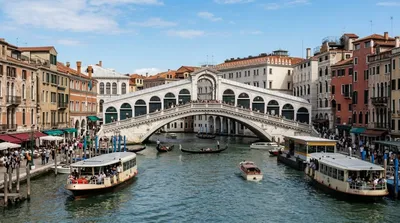
The Rialto Bridge is the oldest of the four bridges crossing Venice's Grand Canal, linking the San Marco and San Polo districts. First built as a pontoon bridge in 1173, it has been rebuilt several times, and today's stone bridge draws visitors who come to watch the boats and gondolas on the canal alongside the crowds crossing above.
Nature
Murano
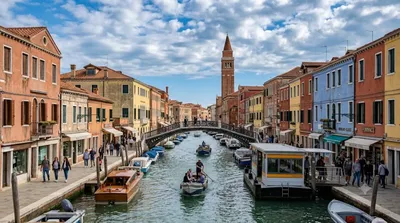
Murano is a cluster of small islands in the Venetian Lagoon linked by bridges, about 1.5 km north of central Venice. Once an independent municipality, it is now a district of Venice, famous for its centuries-old glassmaking tradition — workshops and furnaces where artisans still blow glass by hand can be found throughout the islands.
Views & landmarks
Bridge of Sighs
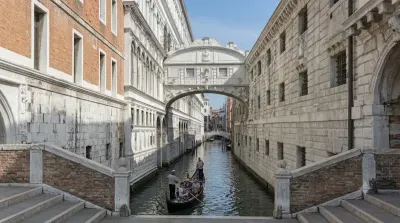
The Bridge of Sighs is a small stone bridge spanning the Rio di Palazzo canal between the Doge's Palace and the Prigioni Nuove (New Prison) opposite it. It is said that convicted prisoners crossed this bridge on their way from the palace to the prison, and the real attraction is less the bridge itself than the view of the narrow canal flanked by buildings on either side.

Nature
Burano
Burano is a small island in the northern Venetian Lagoon, known for its brightly colored fishermen's houses and traditional lace-making. Originally a fishing village, it now relies mainly on tourism, with visitors coming to stroll streets lined with houses painted in different colors, take photos, and browse lace workshops and small shops.
How many days do you need?
Routes grouped by travel distance so each day stays comfortable.
Average temperature by month
5-year average
Getting there
Check flights to Venice first
Pick a departure airport and date to jump straight to results for Venice Marco Polo (VCE).
Check fares and seat availability on the flight search site.
Getting around the city
What you will actually use to get around Venice, and whether you need a car.
- Metro & rail
- No metro, and no cars on the main islands.
- Buses & trams
- The vaporetto is effectively the city bus, running along the Grand Canal and out to islands like Murano and Burano. You will also walk a lot — wheeled luggage struggles on the bridge steps.
- Transit cards & payment
- Vaporetto (water bus) tickets. A time-based pass pays off if you ride several times.
- Airport to city
- From Marco Polo, take the Alilaguna water bus or a bus plus a walk. A water taxi is easier with heavy luggage but costly.
- Car rental
- Cars cannot enter the main island at all; you park on the mainland at Piazzale Roma or Mestre.
Book transport
Fares and timetables change often, so we don't list them here. Check the operator or the booking site for current prices and schedules.
Getting to other cities
Useful when you're combining several cities. Times are approximate; fares and timetables change often, so we don't list them.
Transit options connecting Venice and Dolomites.
- Car / Drive · approx. 2 hrs 30 mins to 3 hrs Convenient transit between the two cities. Please check official booking sites for current schedules.
- 직행 Bus · approx. 2 hrs 30 mins to 3 hrs 30 mins Convenient transit between the two cities. Please check official booking sites for current schedules.
- Train + Bus · approx. 3 hrs to 4 hrs Convenient transit between the two cities. Please check official booking sites for current schedules.
Transit options connecting Venice and Florence.
- Train · approx. 2 hrs Convenient transit between the two cities. Please check official booking sites for current schedules.
- Car / Drive · approx. 2 hrs 30 mins Convenient transit between the two cities. Please check official booking sites for current schedules.
- Bus · approx. 3 hrs Convenient transit between the two cities. Please check official booking sites for current schedules.
Transit options connecting Venice and Milan.
- Train · approx. 2 hrs 30 mins Convenient transit between the two cities. Please check official booking sites for current schedules.
- Car / Drive · approx. 3 hrs Convenient transit between the two cities. Please check official booking sites for current schedules.
- Bus · approx. 3~4 hrs Convenient transit between the two cities. Please check official booking sites for current schedules.
Transit options connecting Rome and Venice.
- Train · approx. 3 hrs 30 mins to 4 hrs Convenient transit between the two cities. Please check official booking sites for current schedules.
- Flight · incl. airport transfer approx. 3 hrs to 3 hrs 30 mins Convenient transit between the two cities. Please check official booking sites for current schedules.
- Car / Drive · approx. 4 hrs to 4 hrs 30 mins Convenient transit between the two cities. Please check official booking sites for current schedules.
Transit options connecting Venice and Naples.
- Flight · flight approx. 1 hrs 20 mins, 공항 이동과 수속 포함 door-to-door approx. approx. 3~4 hrs Convenient transit between the two cities. Please check official booking sites for current schedules.
- Train · approx. 6~7 hrs Convenient transit between the two cities. Please check official booking sites for current schedules.
- Bus · approx. 10~12 hrs Convenient transit between the two cities. Please check official booking sites for current schedules.
- Car / Drive · approx. 7~8 hrs Convenient transit between the two cities. Please check official booking sites for current schedules.
Venice Tours & Experiences Booking
Book local tours, tickets, and experiences in advance to enjoy without waiting. Check available products and prices now.
 GetYourGuide
 Klook
Klook
 Tiqets
 KKday
KKday
 WeGoTrip
Check prices and availability on the booking sites.
 Airalo
 Yesim
Yesim
 Saily
Saily
 Drimsim
Where to stay
See all stays →Pick your dates — we'll search Venice hotels for you
Choose dates and guests, and the buttons below will open search results with your criteria. Prices differ between sites, so compare before you book.
 View on Booking.com
 View on Hotels.com
Hotel membership
Staying at Accor hotels often? ALL Accor+ Explorer
A paid annual membership. It includes two free nights a year across Asia-Pacific, 30% off dining and 15% off drinks, and 15% off stays at more than 4,500 hotels worldwide.
Explore the membership
Visit stories: Venice
Have you been to this city?
Share your visit story with photos you took yourself. Once checked, it goes into the Magazine.
Guides by theme
Best value
Where should you stay in Venice for the best value?
Read guide →
5-star & luxury
Where to Stay in Venice for a 5-Star or Luxury Trip
Read guide →
Pool villas & resorts
Where to Stay in Venice for a Pool Villa or Resort
Read guide →
Family travel
Where should families stay in Venice: main island neighborhoods vs. Mestre?
Read guide →
Couples & honeymoon
Where Should Couples Stay in Venice for a Honeymoon?
Read guide →
Central & near stations
Where should you stay in Venice if you want to be central and near the stations?
Read guide →
Best time to visit
When Should You Visit Venice? A Season-by-Season Guide to Weather, Crowds, and Tides
Read guide →
First-time guide
How to plan your first trip to Venice: districts, airport transfer, and getting around without cars
Read guide →
Getting around
How do you get around Venice without a car or a metro?
Read guide →