
Venice · Couples & honeymoon
Where Should Couples Stay in Venice for a Honeymoon?
August 2, 2026 · last updated · about 4 min read
Where Should Couples Stay in Venice?
Venice has no cars and no metro, so the district you pick decides how much walking and vaporetto time separates you from dinner each night. For a honeymoon, a quiet base near a canal often matters more than proximity to Piazza San Marco.
Dorsoduro
An arty, residential quarter near the Accademia and Zattere waterfront, quieter after early evening. Suits couples wanting canalside walks over nightlife.
San Marco / San Polo
The most central area, walkable to the Basilica and Rialto Bridge, but also the most crowded and expensive, with canal-facing rooms prone to early-morning boat noise.
Cannaregio
A quieter, local district north of the Rialto, with the Fondamenta della Misericordia known for evening aperitivo and easy walking access to the station and Rialto.
Giudecca and Mestre
Giudecca faces Dorsoduro; calm, but reaching the sights needs a vaporetto. Mestre, on the mainland, is about ten minutes by train and trades the car-free atmosphere for lower costs and easier luggage handling.
Transport and Airport
Movement is on foot, by vaporetto, or water taxi. From Marco Polo Airport (VCE): the Alilaguna water bus, a bus/taxi to Piazzale Roma then a vaporetto or walk, or a water taxi direct to your hotel's dock. Bridges make wheeled luggage hard, so check the walk to the nearest stop.
Before You Book
- Canal view (romantic, but possible boat noise) versus a quieter courtyard room.
- Stair access, since many historic buildings have no elevator.
- Walking distance to the nearest vaporetto stop with luggage.
- Acqua alta flood risk in autumn/early spring, especially in low-lying San Marco.
When to Visit
Spring, summer, Carnevale in February, and the Biennale bring heavy demand, so book central rooms early. April–May and Sept–Oct balance weather and crowds; Nov–Feb is quieter but risks acqua alta.
Pick your dates — we'll search Venice hotels for you
Choose dates and guests, and the buttons below will open search results with your criteria. Prices differ between sites, so compare before you book.
 View on Booking.com
 View on Hotels.com
Things to see in Venice
See all →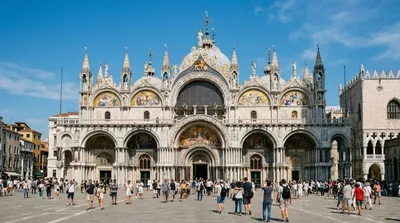
Temples & religious sites
St Mark's Basilica
St Mark's Basilica is the patriarchal cathedral of Venice, said to hold the relics of the Evangelist Mark. It became the cathedral in 1807, succeeding San Pietro di Castello, and is known for its Byzantine interior and façade covered in gold mosaics — a highlight for anyone interested in church architecture and religious art.
Museums & galleries
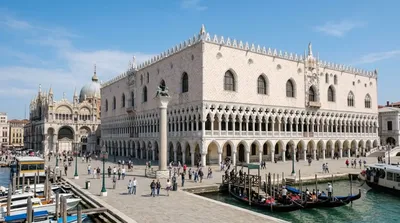
Doge's Palace
The Doge's Palace served as the residence of the Doge, the seat of government, and a prison during the Republic of Venice. Built in Venetian Gothic style, it was first constructed in 810 and rebuilt in 1340, with further additions and renovations over the following centuries. It has operated as a museum since 1923 and is one of eleven museums managed by the Fondazione Musei Civici di Venezia.
Parks & gardens
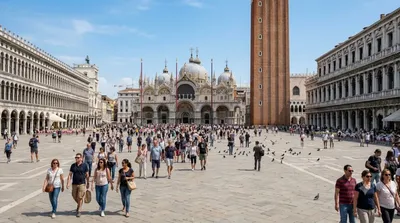
Piazza San Marco
Piazza San Marco is Venice's central square, surrounded by the city's major landmarks, including St. Mark's Basilica, its bell tower, and the Doge's Palace. The square itself is less a destination than a starting point where Venice's most iconic buildings converge, and the arcades lining it are filled with cafés and shops.
Nature
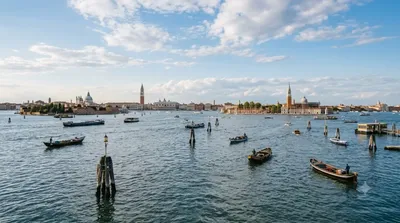
Venetian Lagoon
The Venetian Lagoon is a shallow bay connected to the Adriatic Sea, and the city of Venice itself is built across the many islands scattered within it. In other words, simply walking through St. Mark's Square or crossing the Rialto Bridge already means walking in the middle of the lagoon.
More Venice guides
Best value
Where should you stay in Venice for the best value?
5-star & luxury
Where to Stay in Venice for a 5-Star or Luxury Trip
Pool villas & resorts
Where to Stay in Venice for a Pool Villa or Resort
Family travel
Where should families stay in Venice: main island neighborhoods vs. Mestre?
Central & near stations
Where should you stay in Venice if you want to be central and near the stations?
Best time to visit
When Should You Visit Venice? A Season-by-Season Guide to Weather, Crowds, and Tides
First-time guide
How to plan your first trip to Venice: districts, airport transfer, and getting around without cars
Getting around
How do you get around Venice without a car or a metro?