
 Italy
Italy
Dolomites
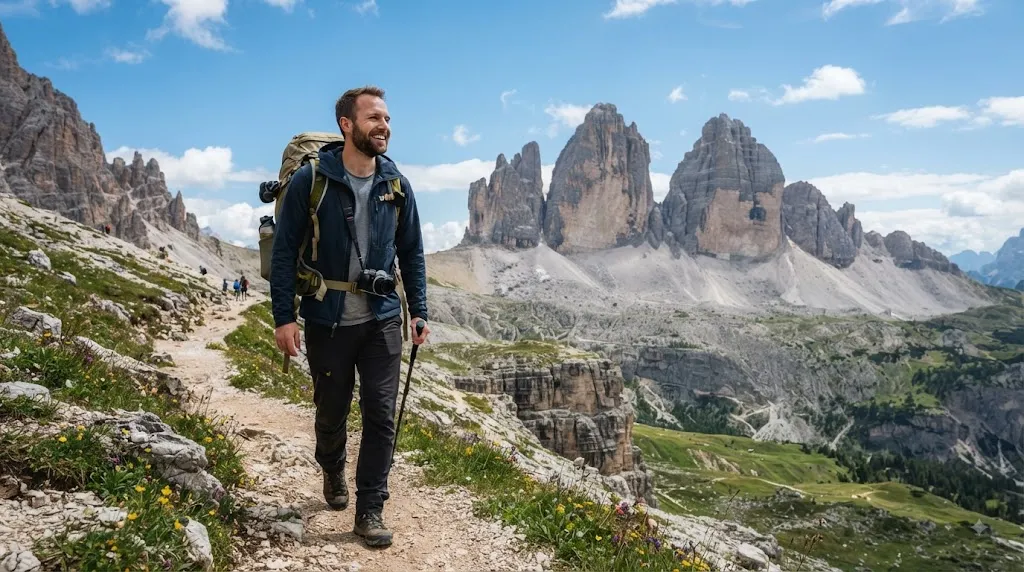
A limestone mountain range in northern Italy and a UNESCO World Heritage site. It is a region rather than a city, so you pick a base village (Cortina d'Ampezzo, Ortisei and the like) and get around by car.
Updated August 15, 2026 · Edited by the World by City editors
- Gateway airport
- Venice Marco Polo (VCE) & Innsbruck (INN)
- Best season
- Jun–Sep (hiking), Dec–Mar (skiing)
- Time zone
- Europe/Rome
- Sights covered
- 42 places
Sights worth seeing
See all 42 →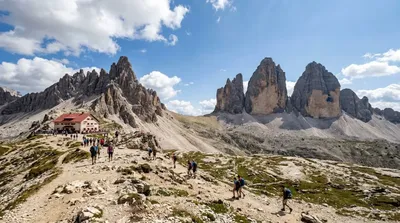
Nature
Tre Cime di Lavaredo
Tre Cime di Lavaredo (German: Drei Zinnen) are three jagged peaks rising in the Sesto Dolomites of northeastern Italy. From west to east stand Cima Ovest, Cima Grande, and Cima Piccola, and their striking wall-like formation makes them one of the signature mountain groups of the Dolomites.
Nature
Drava
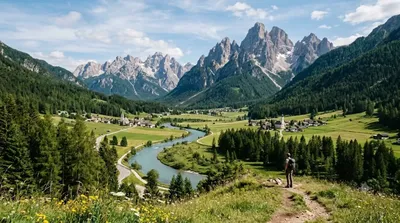
The Drava is a river flowing through the Dolomites, and this stretch marks its uppermost reach, rising in the Val Pusteria near Innichen in South Tyrol, Italy, and flowing eastward. Rather than dramatic waterfalls or gorges, what you'll find here is a clear, gently flowing stream winding through a mountain valley, bordered by meadows and forest.
Nature
Monte Civetta
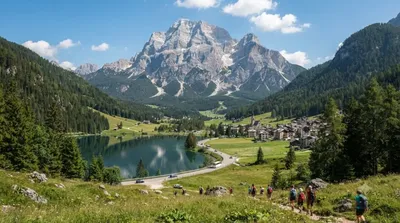
Monte Civetta is one of the Dolomites' major peaks in Italy's Belluno province, often regarded as a symbol of the range. It's especially famous for its northwest face as seen from the valley near Taibon Agordino, where a vast, near-vertical wall of rock dominates the entire valley.
Nature
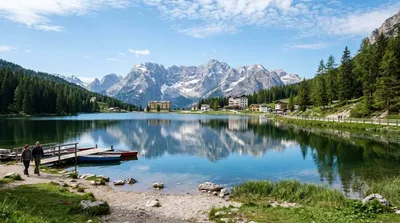
Lake Misurina
Lake Misurina is the largest natural lake in the Cadore area, sitting at 1,754 meters above sea level. Its 2.6km shoreline makes for an easy walk around, and the view across the water to the Cadini group and Sorapis range makes it a popular photo spot. With a maximum depth of just 5 meters, the water looks clear and still.
Nature
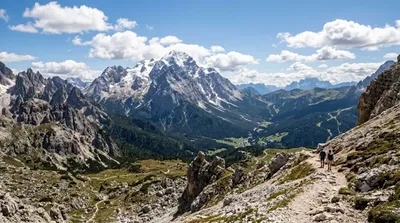
Antelao
Antelao is the highest peak in the eastern Dolomites of northeastern Italy, rising in the Cadore region southeast of Cortina d'Ampezzo. Its solitary, towering shape sets it apart from surrounding peaks, drawing many travelers for climbing and high-altitude trekking. Even without reaching the summit, trails along its base offer close views of the Dolomites' distinctive limestone cliffs and spires.
Nature
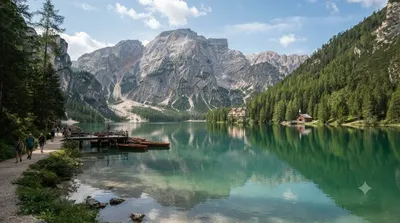
Pragser Wildsee
Pragser Wildsee (Lago di Braies) is a natural lake in the Prags Valley of the Dolomites, South Tyrol, Italy. It's known for its deep turquoise water set against the rock walls of the Croda Rossa massif, with an easy circular path around the shore that lets visitors take in the whole lake without much exertion. Traditional wooden rowboats can also be rented for views of the surrounding mountains from the water.
Nature
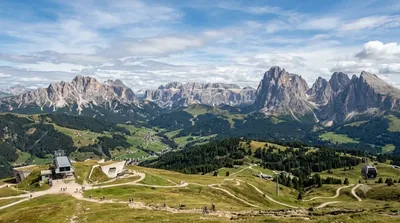
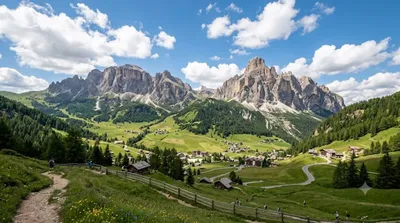
Kronplatz
Kronplatz is a mountain in the Dolomites of South Tyrol, northern Italy, rising to 2,275 meters. Cable cars and gondolas make the summit easily accessible, drawing skiers in winter and hikers seeking panoramic views in summer. The summit is also home to the Messner Mountain Museum Corones, offering more to see beyond the climb itself.
Nature
Alta Badia
Alta Badia is a mountain region in the upper Val Badia, part of the Dolomites in northern Italy, spanning the three villages of Corvara, Badia, and La Val. It belongs to the Dolomiti Superski area and draws visitors for skiing and snowboarding in winter, hiking and mountain biking in summer.
How many days do you need?
Routes grouped by travel distance so each day stays comfortable.
Average temperature by month
5-year average
Getting there
Check flights to Dolomites first
Pick a departure airport and date to jump straight to results for Venice Marco Polo (VCE) & Innsbruck (INN).
Check fares and seat availability on the flight search site.
Getting around the city
What you will actually use to get around Dolomites, and whether you need a car.
- Metro & rail
- No metro. In the mountains, rail only runs along parts of the valleys.
- Buses & trams
- In the summer season, intercity buses link the main passes and lakes. Frequency varies a lot by season and routes thin out in winter, so always check the timetable for your dates. Some places, such as Lago di Braies, restrict cars in peak season — a bus or shuttle can be the easier option.
- Transit cards & payment
- Regional transit cards (such as the Mobilcard) exist, and some accommodation hands out a guest card — worth asking at check-in.
- Airport to city
- Venice Marco Polo is the usual gateway. Seasonal buses run from the airport to Cortina; otherwise it is a drive.
- Car rental
- You really need a car to cover the Dolomites. Pass roads are winding, and winter brings snow chain or winter tyre requirements on some stretches. Even in summer, car parks at popular spots fill early, so an early start helps.
Book transport
Fares and timetables change often, so we don't list them here. Check the operator or the booking site for current prices and schedules.
Getting to other cities
Useful when you're combining several cities. Times are approximate; fares and timetables change often, so we don't list them.
Transit options connecting Venice and Dolomites.
- Car / Drive · approx. 2 hrs 30 mins to 3 hrs Convenient transit between the two cities. Please check official booking sites for current schedules.
- 직행 Bus · approx. 2 hrs 30 mins to 3 hrs 30 mins Convenient transit between the two cities. Please check official booking sites for current schedules.
- Train + Bus · approx. 3 hrs to 4 hrs Convenient transit between the two cities. Please check official booking sites for current schedules.
Transit options connecting Milan and Dolomites.
- Car / Drive · approx. 4~5 hrs Convenient transit between the two cities. Please check official booking sites for current schedules.
- Train + Bus · approx. 5~7 hrs Convenient transit between the two cities. Please check official booking sites for current schedules.
- Bus · approx. 5~6 hrs Convenient transit between the two cities. Please check official booking sites for current schedules.
Transit options connecting Florence and Dolomites.
- Car / Drive · approx. 4~5 hrs Convenient transit between the two cities. Please check official booking sites for current schedules.
- Train + Bus · approx. 5~6 hrs Convenient transit between the two cities. Please check official booking sites for current schedules.
- Flight + 육상 이동 · approx. 5~7 hrs (환승 포함) Convenient transit between the two cities. Please check official booking sites for current schedules.
Transit options connecting Rome and Dolomites.
- Train + Bus/Rental Car · total approx. 6~7 hrs Convenient transit between the two cities. Please check official booking sites for current schedules.
- Flight + Rental Car/Bus · total approx. 4~5 hrs(incl. airport transfer) Convenient transit between the two cities. Please check official booking sites for current schedules.
- Car / Rental Car · approx. 6~7 hrs Convenient transit between the two cities. Please check official booking sites for current schedules.
- Long-Distance Bus · approx. 9~10 hrs or more Convenient transit between the two cities. Please check official booking sites for current schedules.
Transit options connecting Naples and Dolomites.
- Flight (나폴리 → 베네치아, 이후 육로 연결) · flight approx. 1 hrs 15 mins, 돌로미티 마을 추가로 approx. 2~3 hrs Convenient transit between the two cities. Please check official booking sites for current schedules.
- Train · 전체 approx. 6~8 hrs Convenient transit between the two cities. Please check official booking sites for current schedules.
- Car / Drive · approx. 7~8 hrs Convenient transit between the two cities. Please check official booking sites for current schedules.
Dolomites Tours & Experiences Booking
Book local tours, tickets, and experiences in advance to enjoy without waiting. Check available products and prices now.
 GetYourGuide
 Klook
Klook
 Tiqets
 KKday
KKday
 WeGoTrip
Check prices and availability on the booking sites.
 Airalo
 Yesim
Yesim
 Saily
Saily
 Drimsim
Where to stay
See all stays →Pick your dates — we'll search Dolomites hotels for you
Choose dates and guests, and the buttons below will open search results with your criteria. Prices differ between sites, so compare before you book.
 View on Booking.com
 View on Hotels.com
Hotel membership
Staying at Accor hotels often? ALL Accor+ Explorer
A paid annual membership. It includes two free nights a year across Asia-Pacific, 30% off dining and 15% off drinks, and 15% off stays at more than 4,500 hotels worldwide.
Explore the membership
Visit stories: Dolomites
Have you been to this city?
Share your visit story with photos you took yourself. Once checked, it goes into the Magazine.
Guides by theme
Best value
Where should you stay in the Dolomites for the best value?
Read guide →
5-star & luxury
Where should you stay in the Dolomites for a 5-star, luxury trip?
Read guide →
Pool villas & resorts
Where Should You Base Yourself in the Dolomites for a Pool Villa or Resort Stay?
Read guide →
Family travel
Where should families stay in the Dolomites, and how do they get around?
Read guide →
Couples & honeymoon
Where should couples stay in the Dolomites for a honeymoon trip?
Read guide →
Central & near stations
Where to stay in the Dolomites for a central, station-linked base
Read guide →
Best time to visit
When Is the Best Time to Visit the Dolomites, Italy?
Read guide →
First-time guide
How to Plan Your First Trip to the Dolomites, Italy
Read guide →
Getting around
How do you get around the Dolomites without a metro or a single city center?
Read guide →