
Naples · Family travel
Where should families stay in Naples?
August 2, 2026 · last updated · about 3 min read
Choosing a base in Naples for family travel
Naples rewards families who stay somewhere calm to retreat to, since street life is intense day and night. The best areas balance easy transport to Pompeii, Capri, and the Amalfi Coast with a quieter walk back to the room.
Chiaia
A residential, seafront-adjacent district with wide pavements and the Villa Comunale park for kids to run in. Calmer evenings than the historic center, and it suits families with strollers or younger children.
Vomero
Up on the hill, Vomero is quieter and more suburban, with its own shops and a park near Castel Sant'Elmo. It connects to the center by funicular, which doubles as normal transit and as a ride kids enjoy. Good for a break from the crowds each evening.
Toledo / Municipio
Central and walkable to the ferry terminal at Molo Beverello for Capri and the Amalfi Coast, and to Line 1, whose Toledo, Municipio, and Università stations are worth seeing as art installations in their own right. Busier, but convenient for island-hopping.
Near Garibaldi
Closest to the main station and the Circumvesuviana line to Pompeii and Sorrento, but grittier, and it requires more vigilance with bags and pockets with children in tow.
What to check before booking
- Distance to a Line 1 or Line 2 station, or a funicular stop if staying on the hill
- Whether reaching Pompeii or Sorrento means changing to the Circumvesuviana at Garibaldi
- Noise levels at night on a main street, common in the historic center
- Lift access, since many older Naples buildings have narrow stairs
When to visit
Spring and early autumn bring milder weather for day trips to Pompeii and the coast, without peak summer crowds. Rooms are easier to find than in July and August, when coastal excursions push demand up across all these areas.
Pick your dates — we'll search Naples hotels for you
Choose dates and guests, and the buttons below will open search results with your criteria. Prices differ between sites, so compare before you book.
 View on Booking.com
 View on Hotels.com
Things to see in Naples
See all →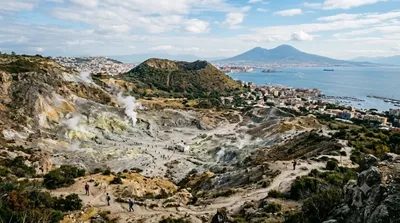
Nature
Phlegraean Fields
The Phlegraean Fields are a vast volcanic caldera west of Naples, so close to the city that part of Naples itself sits atop it. The terrain, shaped by volcanic activity, is dotted with fumaroles and other signs of geothermal activity, and the area is often described in the media as a "supervolcano."

Culture & venues
Teatro di San Carlo
The Teatro di San Carlo, next to the Royal Palace of Naples, is an opera house that opened in 1737 and is known as the world's oldest continuously operating opera house. Having been built before Milan's La Scala and Venice's La Fenice, it offers a firsthand look at the history of Italian opera.

Museums & galleries
Naples National Archaeological Museum
The National Archaeological Museum of Naples is one of Italy's leading archaeological museums, holding artifacts from the Greek, Roman, and Renaissance periods. Its core collection centers on Roman-era finds excavated from nearby Pompeii, Stabiae, and Herculaneum, and it's especially known for its mosaics and sculptures. From 1816 to 1861, it was known as the "Royal Bourbon Museum."

Museums & galleries
Museo di Capodimonte
The Capodimonte Museum is a national art museum housed in the Royal Palace of Capodimonte, built by the Bourbon dynasty in the 18th century. It grew out of the Farnese family's collection and the royal holdings of the Kingdom of Naples, and is considered to hold the richest collection of Neapolitan school paintings and decorative arts.
More Naples guides
Best value
Where should I stay in Naples for the best value?
5-star & luxury
Where to stay in Naples for a 5-star or luxury hotel: waterfront, Chiaia, or Vomero, and how each connects to transport and sights.
Pool villas & resorts
Where should you stay near Naples for a pool villa or resort?
Couples & honeymoon
Where should couples stay in Naples for a honeymoon trip?
Central & near stations
Where to Stay in Naples Near the Metro and Train Stations
Best time to visit
When Is the Best Time to Visit Naples, Italy?
First-time guide
How should a first-time visitor plan a trip to Naples, Italy?
Getting around
How do you get around Naples and reach Pompeii or the Amalfi Coast?
Family travel guides for other destinations
Guantánamo
Where to stay in Guantánamo with children: Best areas and family accommodation guide
Cetinje
Where to stay in Cetinje for a family trip: Best areas and practical booking advice
North Nicosia
Where to stay in North Nicosia for a family trip
Banja Luka
Where to stay in Banja Luka for a family trip: best neighborhoods and practical tips