World by City

Nature

Phlegraean Fields
Phlegraean Fields

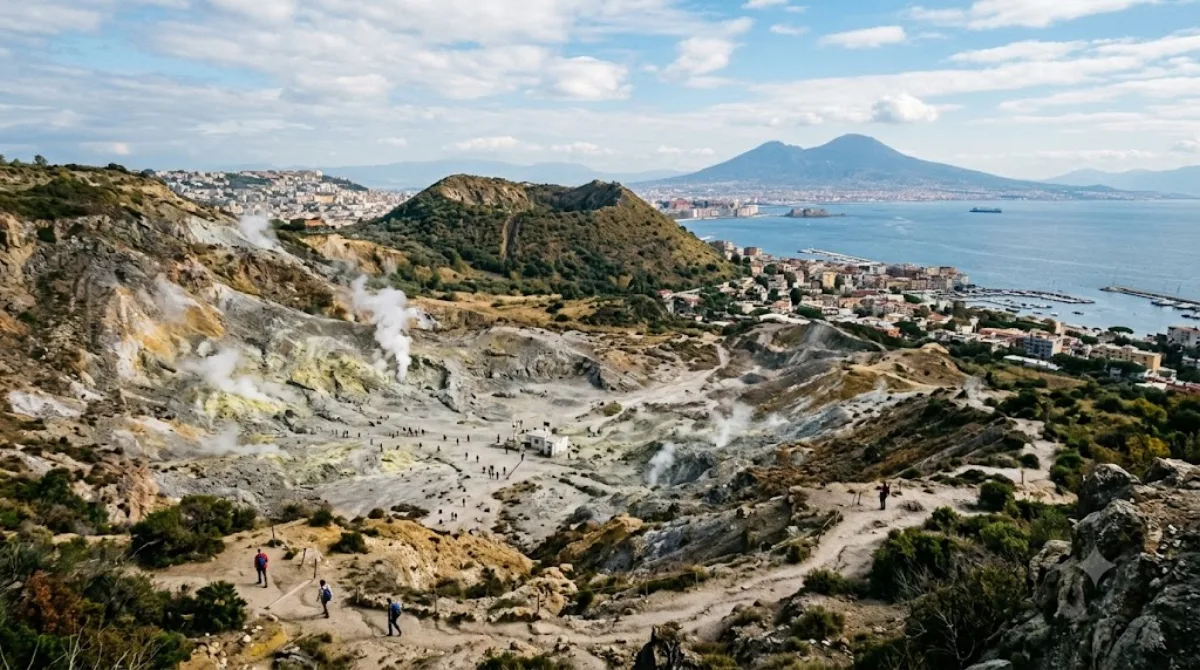
The Phlegraean Fields is a large volcanic caldera west of Naples, Italy. The Neapolitan Yellow Tuff eruption produced just 50 cubic kilometers. It is, however, one of relatively few volcanoes large enough to form a caldera. It is part of the Campanian volcanic arc, which includes Mount Vesuvius, about 9 km east of Naples. The Phlegraean Fields is monitored by the Vesuvius Observatory. Part of the city of Naples is built over it. The Phlegraean Fields' largest known eruptions have an estimated volcanic explosivity index (VEI) of 7. It is often called a supervolcano in popular media, although th...

What it is

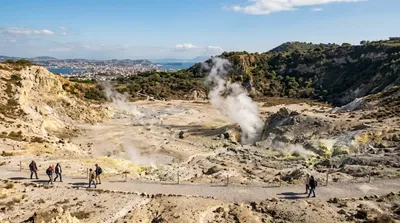
The Phlegraean Fields is a volcanic caldera spread across the area west of Naples, largely hidden because a chunk of the city itself is built over it. Rather than a single cone like Vesuvius, it's a landscape of craters, crater lakes, fumaroles and hot springs, shaped by thousands of years of eruptions and ongoing ground movement. The main appeal for visitors is walking through an active volcanic system at ground level, seeing steaming vents and sulphur-stained earth up close rather than looking at a mountain from a distance.

Getting there

The caldera area is reached from central Naples by local train (Cumana line) or metro toward Pozzuoli, with a journey of roughly 20-40 minutes depending on which part of the Fields you're heading to. A car gives more flexibility for reaching the scattered craters and viewpoints, but parking and small roads can slow things down.

Time to allow

Allow at least half a day to see one or two sites properly, such as a crater walk plus a viewpoint. A full day lets you combine several stops without rushing.

When to go

Go earlier in the day to avoid the strongest heat, since much of the walking is on open, shadeless volcanic ground. Sulphur smells from the fumaroles are constant and can be strong; this isn't seasonal, just something to expect.

Combine it with

  • Solfatara (0km) — the volcanic crater within the Fields itself, effectively the same stop.
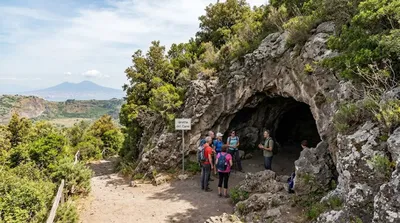
  • Cave of Dogs (2.4km) — a short trip away, a historic natural curiosity tied to the area's volcanic gas activity.
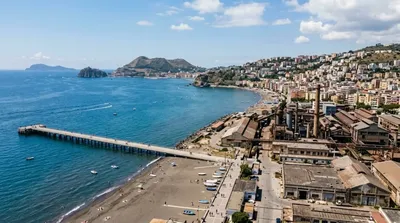
  • Bagnoli (2.7km) — a nearby coastal district, worth pairing if you want a sea view after the volcanic terrain.
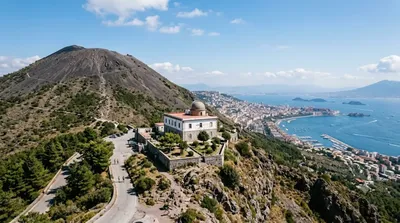
  • Vesuvius Observatory (3.7km) — relevant if you're interested in how the whole volcanic zone, including Vesuvius, is monitored.

Sources: open data from Wikipedia and OpenStreetMap · Updated August 5, 2026 · Edited by the World by City editors

Tickets & tours

Admission prices and opening hours change often, so we don't list them here. Check what's on sale and at what price below — booking ahead can cut the queue at some places.

This place may not appear in the results — some sites are free to enter or sell tickets only at the gate.

Stays near Phlegraean Fields

Sorted by distance, walkable ones first. Distances are straight-line.

Map © OpenStreetMap contributors. Lines are straight connections, not actual routes.

Phlegraean Fields Nearby stays

Locations and names come from OpenStreetMap. Check prices and availability on the booking sites.

Itineraries including this place

Good to visit alongside

Solfatara

Nature

Solfatara

Solfatara is a shallow volcanic crater at Pozzuoli, near Naples, part of the Phlegraean Fields volcanic area. It is a volcano, which emits jets of steam with sulfurous fumes. The name comes from the Latin, Sulpha terra, "land of sulfur", or "sulfur earth". It was formed around 4000 years ago and last erupted in 1198 with what was probably a phreatic eruption – an explosive steam-driven eruption caused when groundwater interacts with magma. The crater floor was a popular tourist attraction until 2017, as it has many fumaroles and mud pools. The area is well known for its bradyseism. The vapours...

0.0 km away

Cave of Dogs

Nature

Cave of Dogs

The Cave of Dogs is a cave near Naples, Italy. Volcanic gases seeping into the cave give the air inside a high concentration of carbon dioxide. Dogs held inside would faint; at one time this was a tourist attraction.

2.4 km away

Bagnoli

Shopping & districts

Bagnoli

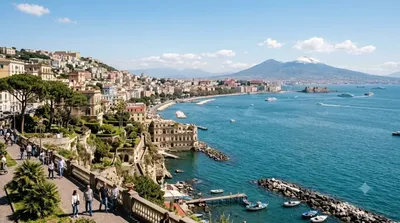
Bagnoli is a western seaside quarter of Naples, Italy, well beyond the confines of the original city. It is beyond Cape Posillipo and, thus, looking on the coast of the Bay of Pozzuoli.

2.7 km away

Vesuvius Observatory

Nature

Vesuvius Observatory

The Vesuvius Observatory is the surveillance centre for monitoring the three volcanic areas of Campania, Italy: Mount Vesuvius, the Phlegrean Fields and Ischia. Founded in 1841 on the slopes of Mount Vesuvius by Ferdinand II of Bourbon, King of the Two Sicilies, it is the oldest volcanology institute in the world. Its current operative center is based in Naples, hosting an important section of the National Institute of Geophysics and Volcanology.

3.7 km away

Nisida

Nature

Nisida

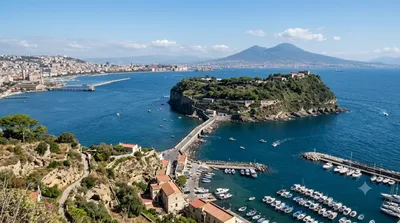
Nisida is a volcanic islet of the Flegrean Islands archipelago, in southern Italy. It lies at a very short distance from Cape Posillipo, southwest of Naples; it is connected to the mainland by a camera-enforced 1km-long pedestrian zone. The islet is almost circular, with a flooded crater forming the bay of Porto Paone on the southwest coast. It has a diameter of about 0.5 kilometres and a highest altitude of 105 metres.

4.1 km away

Posillipo

Shopping & districts

Posillipo

Posillipo is an affluent residential quarter of Naples, southern Italy, located along the northern coast of the Gulf of Naples.

5.9 km away