
Naples · Getting around
How do you get around Naples and reach Pompeii or the Amalfi Coast?
August 13, 2026 · last updated · about 5 min read
Getting around Naples
The historic center (Spaccanapoli, Quartieri Spagnoli, Duomo) is dense and best covered on foot — many streets are too narrow or crowded for buses to be useful. For longer hops, especially up and down the hills toward Vomero, the metro and funiculars do the heavy lifting.
Metro
Line 1 links the center (Municipio, Toledo, Dante) with Vomero and the northern suburbs; several stations, including Toledo and Municipio, are treated as art installations with mosaics and light features, so it's worth riding even a stop or two just to see them. Line 2 is faster for east-west trips (Cavalleggeri to Piazza Garibaldi/Napoli Centrale) but has less frequent service and plainer stations.
Funiculars
Naples has several funicular lines (Centrale, Montesanto, Chiavamone) climbing to Vomero — these count as regular transit, not tourist rides, and are the quickest way up the hill, especially with luggage, avoiding switchback roads.
Buses and trains for day trips
City buses cover flatter areas the metro misses but sit in traffic. For Pompeii and Sorrento, the Circumvesuviana suburban rail line is the standard option; it's crowded and best boarded early, with bags kept close.
Tickets and passes
A single Unico Campania ticket covers metro, funicular, and city buses within a validity window and is the simplest option for short stays. Day passes suit anyone doing several hill crossings or museum-hopping; they don't suit visitors sticking to one neighborhood on foot, where single tickets are cheaper overall.
From Capodichino Airport (NAP)
The Alibus shuttle runs from the airport to Piazza Garibaldi (Napoli Centrale) and Piazza Municipio, taking roughly 20-30 minutes depending on traffic — the lowest-effort, lowest-cost option, though standing room only at peak times. Taxis operate on a fixed flat fare to the city center and are worth it with heavy luggage or late arrivals. There is no direct rail or metro link from the airport itself.
Practical notes
Rush hours (roughly 7:30-9:30 and 17:30-19:30) get metro cars and funiculars packed; avoid these with bulky luggage. Last metro and funicular runs are typically before midnight, earlier on Sundays, so plan late returns by taxi. Pickpocketing is a real concern on crowded buses and the Circumvesuviana — keep bags zipped and in front of you. Step-free access exists at newer Line 1 stations but is inconsistent elsewhere, so travelers with mobility needs should check specific stations in advance.
Pick your dates — we'll search Naples hotels for you
Choose dates and guests, and the buttons below will open search results with your criteria. Prices differ between sites, so compare before you book.
 View on Booking.com
 View on Hotels.com
Things to see in Naples
See all →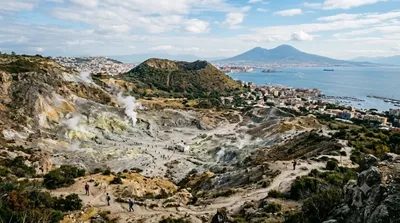
Nature
Phlegraean Fields
The Phlegraean Fields are a vast volcanic caldera west of Naples, so close to the city that part of Naples itself sits atop it. The terrain, shaped by volcanic activity, is dotted with fumaroles and other signs of geothermal activity, and the area is often described in the media as a "supervolcano."
Culture & venues
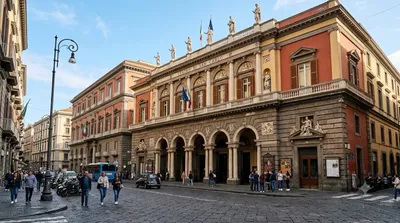
Teatro di San Carlo
The Teatro di San Carlo, next to the Royal Palace of Naples, is an opera house that opened in 1737 and is known as the world's oldest continuously operating opera house. Having been built before Milan's La Scala and Venice's La Fenice, it offers a firsthand look at the history of Italian opera.

Museums & galleries
Naples National Archaeological Museum
The National Archaeological Museum of Naples is one of Italy's leading archaeological museums, holding artifacts from the Greek, Roman, and Renaissance periods. Its core collection centers on Roman-era finds excavated from nearby Pompeii, Stabiae, and Herculaneum, and it's especially known for its mosaics and sculptures. From 1816 to 1861, it was known as the "Royal Bourbon Museum."

Museums & galleries
Museo di Capodimonte
The Capodimonte Museum is a national art museum housed in the Royal Palace of Capodimonte, built by the Bourbon dynasty in the 18th century. It grew out of the Farnese family's collection and the royal holdings of the Kingdom of Naples, and is considered to hold the richest collection of Neapolitan school paintings and decorative arts.
More Naples guides
Best value
Where should I stay in Naples for the best value?
5-star & luxury
Where to stay in Naples for a 5-star or luxury hotel: waterfront, Chiaia, or Vomero, and how each connects to transport and sights.
Pool villas & resorts
Where should you stay near Naples for a pool villa or resort?
Family travel
Where should families stay in Naples?
Couples & honeymoon
Where should couples stay in Naples for a honeymoon trip?
Central & near stations
Where to Stay in Naples Near the Metro and Train Stations
Best time to visit
When Is the Best Time to Visit Naples, Italy?
First-time guide
How should a first-time visitor plan a trip to Naples, Italy?
Getting around guides for other destinations
Guantánamo
How to Get Around Guantánamo and Travel from Antonio Maceo Airport
Cetinje
How to Get Around Cetinje and Travel from Podgorica Airport
North Nicosia
How to get around North Nicosia and travel from Larnaca Airport
Cienfuegos
How to get around Cienfuegos: transport options and airport transfers