World by City

Temples & religious sites

Enryaku-ji Temple
Enryaku-ji Temple

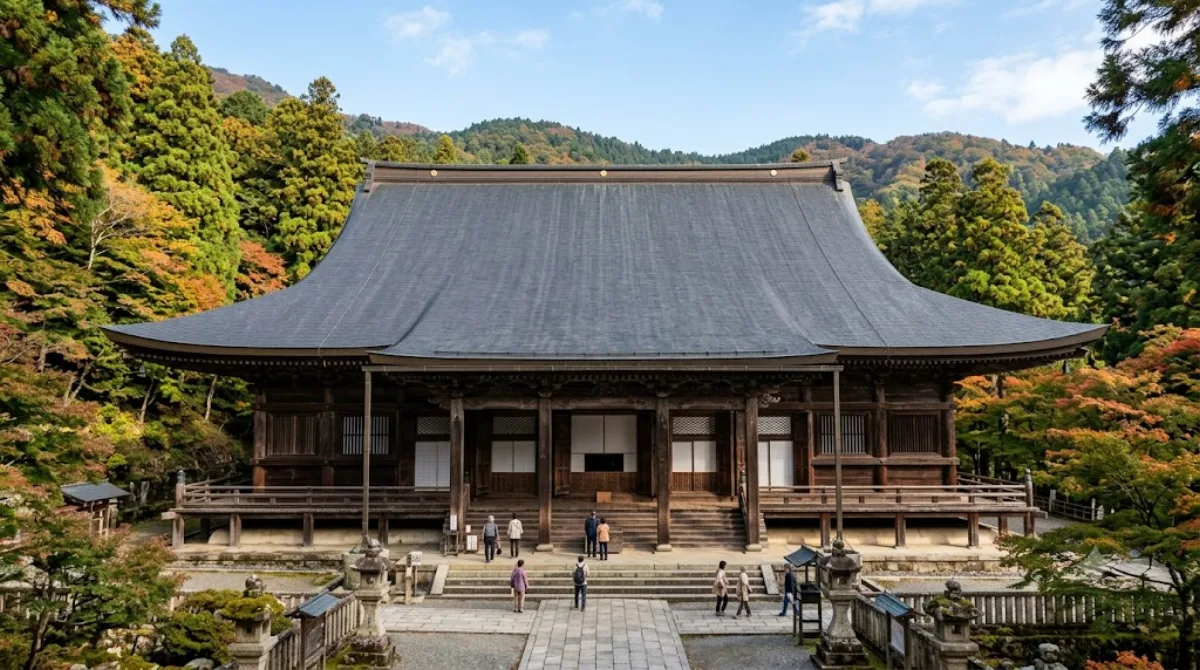
Enryaku-ji is a Tendai monastery located on Mount Hiei in Ōtsu, overlooking Kyoto. It was first founded in 788 during the early Heian period (794–1185) by Saichō (767–822), also known as Dengyō Daishi, who introduced the Tendai sect of Mahayana Buddhism to Japan from China. The temple complex has undergone several reconstruction efforts since then, with the most significant taking place in 1642 under Tokugawa Iemitsu. Enryaku-ji is the headquarters of the Tendai sect and one of the most significant monasteries in Japanese history. As such, it is part of the UNESCO World Heritage Site "Histori...

What it is

Enryaku-ji is the headquarters of the Tendai school of Buddhism, spread across the wooded summit and slopes of Mount Hiei above Kyoto. Founded in 788 by the monk Saichō, it grew into one of the most influential monastic centres in Japanese history, training reformist monks and, at various points, fielding its own armed warrior-monks. The complex is divided into three precincts — Tōdō, Saitō, and Yokawa — spread across the mountain, each with its own halls, and connected by shuttle bus or hiking trails. The main hall, Konpon Chudo, in the Tōdō area, holds an oil lamp said to have burned continuously since the temple's founding.

Getting there

From central Kyoto, take the Eizan Cable Line and ropeway from Yase (reached by the Eizan Railway from Demachiyanagi Station) up to the summit, a combined trip of around an hour including the train ride. Alternatively, a bus route runs up from Kyoto Station or Sakamoto, on the Shiga side of the mountain, in roughly 50–70 minutes depending on the route and traffic.

Time to allow

Plan on at least half a day. Seeing just the Tōdō precinct takes about 1–1.5 hours; visiting all three precincts, which are spread apart and linked by shuttle bus, takes closer to 3–4 hours.

When to go

Go earlier in the day, since the mountain can cloud over or turn foggy by afternoon, and check weather before heading up. Autumn foliage draws heavy crowds and can mean queues for the cable car; a weekday visit is easier going. The mountain is noticeably cooler than the city, so bring a layer even in summer.

Combine with

Mii-dera Temple (6.5km) sits on the Shiga side of the mountain and pairs naturally with a Sakamoto-route visit. Ginkaku-ji (6.2km) and Nanzen-ji (7.9km) are both on the Kyoto side and can be combined with each other, though visiting them the same day as Enryaku-ji makes for a long day given the travel time up and down the mountain.

Sources: open data from Wikipedia and OpenStreetMap · Updated August 5, 2026 · Edited by the World by City editors

Tickets & tours

Admission prices and opening hours change often, so we don't list them here. Check what's on sale and at what price below — booking ahead can cut the queue at some places.

This place may not appear in the results — some sites are free to enter or sell tickets only at the gate.

Stays near Enryaku-ji Temple

Sorted by distance, walkable ones first. Distances are straight-line.

Map © OpenStreetMap contributors. Lines are straight connections, not actual routes.

Enryaku-ji Temple Nearby stays

Locations and names come from OpenStreetMap. Check prices and availability on the booking sites.

Good to visit alongside

Ginkaku-ji Temple

Temples & religious sites

Ginkaku-ji Temple

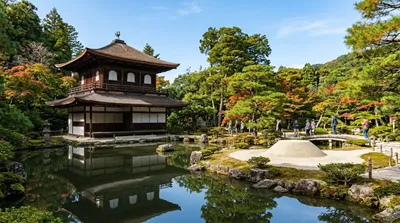
Ginkaku-ji , officially named Jishō-ji , is a Zen temple in the Sakyo ward of Kyoto, Japan. It is one of the constructions that represent the Higashiyama Culture of the Muromachi period.

6.2 km away

Mii-dera Temple

Temples & religious sites

Mii-dera Temple

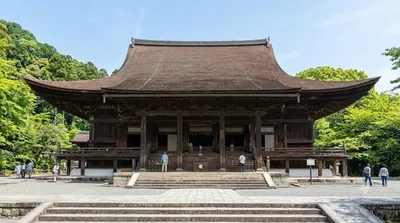
Nagara-san Onjo-ji , also known as just Onjo-ji, or Mii-dera (三井寺), is a Buddhist temple in Japan located at the foot of Mount Hiei, in the city of Ōtsu in Shiga Prefecture. It is a short distance from both Kyoto, and Lake Biwa, Japan's largest lake. The head temple of the Jimon sect of Tendai, it is a sister temple to Enryaku-ji, at the top of the mountain, and is one of the four largest temples in Japan. Altogether, there are 40 named buildings in the Mii-dera complex.

6.5 km away

Shimogamo Shrine

Temples & religious sites

Shimogamo Shrine

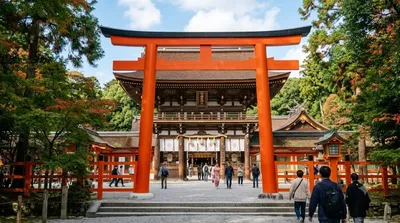
Shimogamo Shrine is an important Shinto sanctuary in the Shimogamo district of Kyoto city's Sakyō ward. Its formal name is Kamo-mioya Shrine . It is one of the oldest Shinto shrines in Japan and is one of the seventeen Historic Monuments of Ancient Kyoto which have been designated by UNESCO as a World Heritage Site. The term Kamo-jinja in Japanese is a general reference to Shimogamo Shrine and Kamigamo Shrine, the traditionally linked Kamo shrines of Kyoto; Shimogamo is the older of the pair, being believed to be 100 years older than Kamigamo, and dating to the 6th century, centuries before K...

7.1 km away

Nanzen-ji Temple

Temples & religious sites

Nanzen-ji Temple

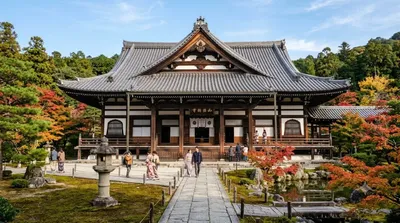
Nanzen-ji , or Zuiryusan Nanzen-ji, formerly Zenrin-ji , is a Zen Buddhist temple in Kyoto, Japan. Emperor Kameyama established it in 1291 on the site of his previous detached palace. It is also the headquarters of the Nanzen-ji branch of Rinzai Zen. The precincts of Nanzen-ji are a nationally designated Historic Site and the Hōjō gardens a Place of Scenic Beauty. The temple was destroyed in a fire in 1895 and rebuilt in 1909.

7.9 km away

Heian Jingū

Temples & religious sites

Heian Jingū

The Heian Shrine is a Shinto shrine located in Sakyō-ku, Kyoto, Japan. The Shrine is ranked as a Beppyō Jinja (別表神社) by the Association of Shinto Shrines. It is listed as an important cultural property of Japan.

8.0 km away

Kamigamo Shrine

Temples & religious sites

Kamigamo Shrine

Kamigamo Shrine is an important Shinto sanctuary on the banks of the Kamo River in north Kyoto, first founded in 678. Its formal name is the Kamo-wakeikazuchi Shrine .

8.1 km away