World by City

Temples & religious sites

Kinkaku-ji Temple
Kinkaku-ji Temple

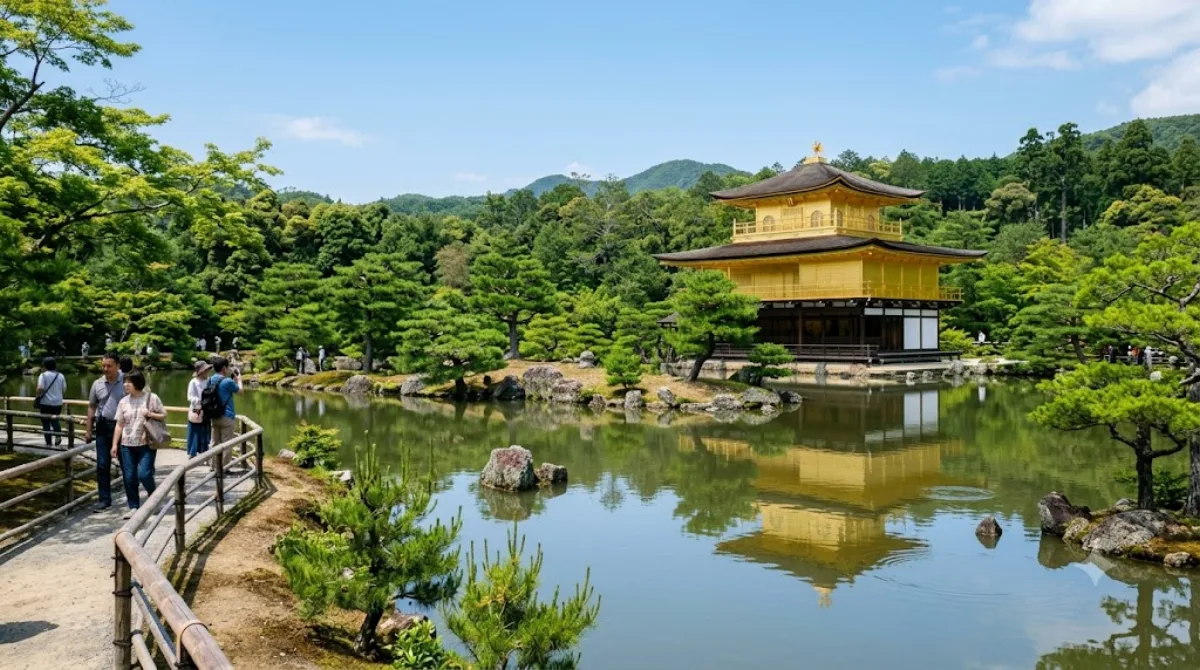
Kinkaku-ji , officially named Rokuon-ji , is a Zen Buddhist temple in Kyoto, Japan and a tourist attraction. It is designated as a World Heritage Site, a National Special Historic Site, a National Special Landscape, and one of the 17 Historic Monuments of Ancient Kyoto. The temple is nicknamed after its reliquary (shariden), the Golden Pavilion , whose top two floors are coated in 0.5 μm gold leaf. The current pavilion was rebuilt in 1955 after being destroyed in an arson attack.

What it is

Kinkaku-ji is a Zen Buddhist temple whose reliquary hall, the Golden Pavilion, has its top two floors covered in gold leaf. The building standing today is a 1955 reconstruction after the original was destroyed by arson, but it's rebuilt to the earlier design and remains the site's main draw. The temple grounds are laid out around a reflecting pond, so most visitors walk a set path along the shore for pavilion views before continuing through the wider garden, which includes smaller structures and tea-related features.

Getting there

From central Kyoto (Kyoto Station area), the temple is reached by city bus, with the ride taking roughly 40-45 minutes depending on traffic. Taxis are faster but costlier. There's no direct subway or train link, so bus or taxi is the practical choice for most visitors staying downtown.

How long to allow

The walking route through the grounds is fixed and relatively short, so 30-45 minutes is usually enough to see the pavilion and complete the loop, unless you want to linger for photos.

When to go

This is one of Kyoto's most visited sites, and it gets crowded, especially late morning through afternoon and on weekends. Arriving close to opening tends to mean thinner crowds. Autumn foliage and spring cherry blossom season bring the heaviest visitor numbers.

Combining with nearby sights

Ryōan-ji Temple, known for its rock garden, is about 1.1km away and is a natural pairing given the short distance. Kitano Tenmangū shrine is 1.3km off, and Ninna-ji Temple is 1.6km away, both reasonable additions if you're spending a half-day in this part of Kyoto. Daitoku-ji Temple, a bit farther at 1.7km, works well if you have more time and want to see its temple complex too.

Sources: open data from Wikipedia and OpenStreetMap · Updated August 5, 2026 · Edited by the World by City editors

Tickets & tours

Admission prices and opening hours change often, so we don't list them here. Check what's on sale and at what price below — booking ahead can cut the queue at some places.

This place may not appear in the results — some sites are free to enter or sell tickets only at the gate.

Stays near Kinkaku-ji Temple

Sorted by distance, walkable ones first. Distances are straight-line.

Map © OpenStreetMap contributors. Lines are straight connections, not actual routes.

Kinkaku-ji Temple Nearby stays

Locations and names come from OpenStreetMap. Check prices and availability on the booking sites.

Itineraries including this place

Good to visit alongside

Ryōan-ji Temple

Temples & religious sites

Ryōan-ji Temple

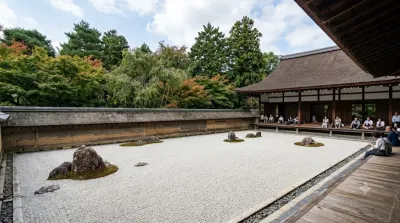
Ryōan-ji is a Zen temple located in northwest Kyoto, Japan. It belongs to the Myōshin-ji school of the Rinzai branch of Zen Buddhism. The Ryōan-ji garden is considered one of the finest surviving examples of kare-sansui, a refined type of Japanese Zen temple garden design generally featuring distinctive larger rock formations arranged amidst a sweep of smooth pebbles raked into linear patterns that facilitate meditation. The temple and its gardens are listed as one of the Historic Monuments of Ancient Kyoto, and as a UNESCO World Heritage Site.

1.1 km away

Kitano Tenmangū

Temples & religious sites

Kitano Tenmangū

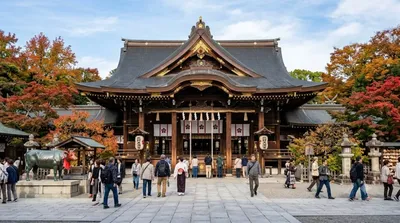
Kitano Tenmangū is a Shinto shrine in Kamigyō-ku, Kyoto, Japan.

1.3 km away

Ninna-ji Temple

Temples & religious sites

Ninna-ji Temple

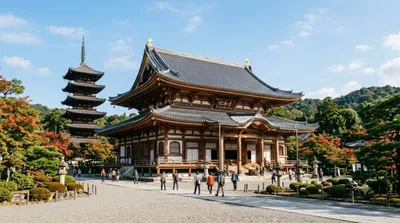
Ninna-ji is the head temple of the Omuro school of the Shingon Sect of Buddhism. Located in western Kyoto, Japan, it was first founded in AD 888 by Emperor Uda, and was later reconstructed in the 17th century. It is part of the Historic Monuments of Ancient Kyoto, a UNESCO World Heritage Site.

1.6 km away

Daitoku-ji Temple

Temples & religious sites

Daitoku-ji Temple

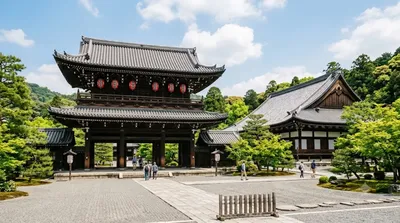
Daitoku-ji is a Rinzai school Zen Buddhist temple in the Murasakino neighborhood of Kita-ku in the city of Kyoto Japan. Its (sangō) is Ryūhōzan (龍宝山). The Daitoku-ji temple complex is one of the largest Zen temples in Kyoto, covering more than 23 hectares. In addition to the main temple complex including the Buddha Hall and the lecture hall, there are more than 20 sub-temples on the grounds. Daitokuji has produced many famous monks and has a deep connection with the tea ceremony culture, making it a temple that has had a great influence on Japanese culture. The main temple and sub-temples...

1.7 km away

Myōshin-ji Temple

Temples & religious sites

Myōshin-ji Temple

Myōshin-ji is a temple complex in Kyoto, Japan, which serves as the head temple of the associated branch of Rinzai Zen Buddhism. The Myōshin-ji School is by far the largest school in Rinzai Zen, approximately as big as the other thirteen branches combined: it contains within it about 3,400 temples throughout Japan, together with a handful overseas, of the approximately six thousand total Rinzai temples, and also has nineteen associated monasteries, of the total of forty Rinzai monasteries and one nunnery.

2.0 km away

Kamo Shrine

Temples & religious sites

Kamo Shrine

Kamo Shrine is a general term for an important Shinto sanctuary complex on both banks of the Kamo River in northeast Kyoto. It is centered on two shrines. The two shrines, an upper and a lower, lie in a corner of the old capital which was known as the "devil's gate" due to traditional geomancy beliefs that the north-east corner brought misfortune. Because the Kamo River runs from the north-east direction into the city, the two shrines along the river were intended to prevent demons from entering the city.

3.2 km away