World by City

Heritage & monuments

Arch of Constantine
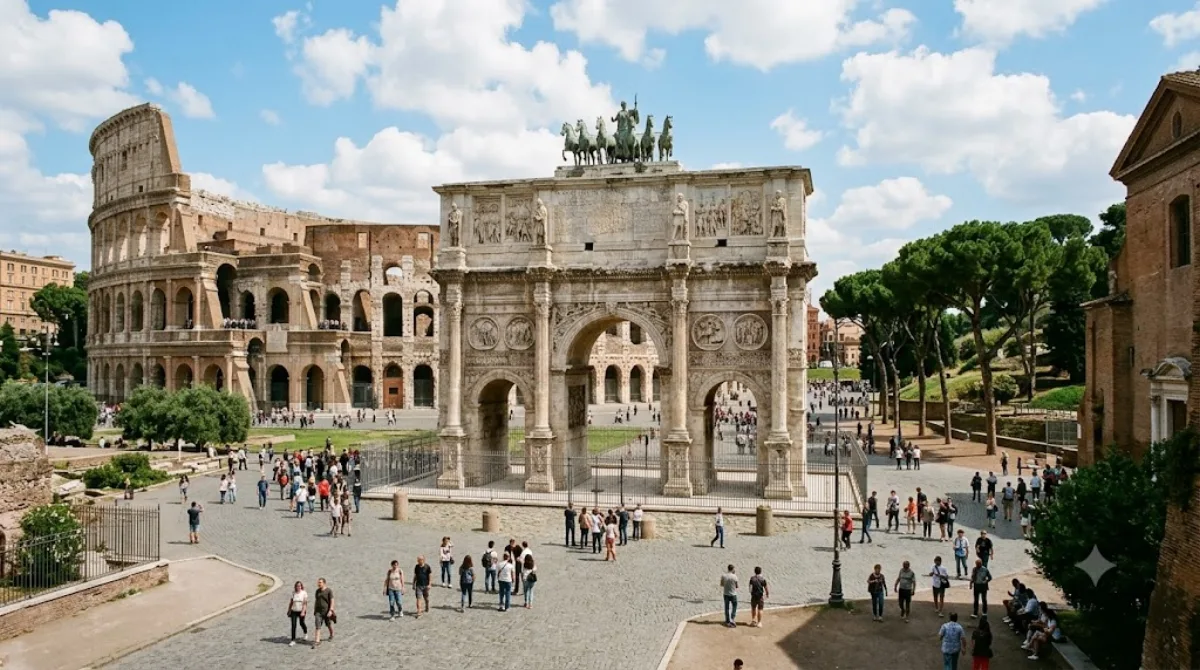
Arch of Constantine

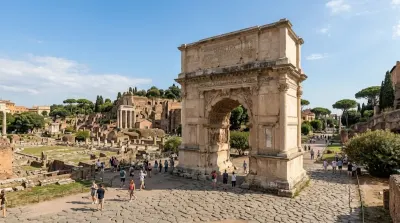
The Arch of Constantine is a triumphal arch in Rome dedicated to the emperor Constantine the Great. The arch was commissioned by the Roman Senate to commemorate Constantine's victory over Maxentius at the Battle of the Milvian Bridge in AD 312. Situated between the Colosseum and the Palatine Hill, the arch spans the Via Triumphalis, the route taken by victorious military leaders when they entered the city in a triumphal procession. Dedicated in 315, it is the largest Roman triumphal arch, with overall dimensions of 21 m (69 ft) high, 25.9 m (85 ft) wide and 7.4 m (24 ft) deep. It has three bay...

Arch of Constantine

This is the largest of the surviving Roman triumphal arches, built by the Senate to honor Constantine's victory over Maxentius at the Milvian Bridge in AD 312. It stands on the ancient triumphal route between the Colosseum and the Palatine Hill, and much of its interest lies in how it was built: alongside new Constantinian work, it reuses relief panels, columns, and statues stripped from earlier monuments to emperors like Trajan and Hadrian, giving it a patchwork quality that's worth a slow look rather than a quick photo.

Getting there

It sits right beside the Colosseum, in the heart of ancient Rome's monument cluster. From the city centre it's an easy walk from most central neighborhoods, or a short ride on Metro Line B to the Colosseo stop, which puts you within a couple of minutes on foot.

How long to spend

The arch itself can be seen properly in 15-20 minutes, since it's viewed from the outside as you pass through the archaeological park.

When to go

The surrounding area is heavily trafficked, as it's the natural approach point for the Colosseum. Early morning or later in the afternoon tends to be calmer for taking photos without crowds in front of the arch.

Combine it with

Its location makes it easy to pair with other sights in the same archaeological zone: the Arch of Titus is just 0.2km away, the Palatine Hill 0.3km, and the Temple of Vesta and Domus Aurea both around 0.4km. Most visitors take it in as part of a single walk through the Colosseum-Palatine-Roman Forum area rather than as a separate stop.

Sources: open data from Wikipedia and OpenStreetMap · Updated August 5, 2026 · Edited by the World by City editors

Tickets & tours

Admission prices and opening hours change often, so we don't list them here. Check what's on sale and at what price below — booking ahead can cut the queue at some places.

This place may not appear in the results — some sites are free to enter or sell tickets only at the gate.

Stays near Arch of Constantine

Sorted by distance, walkable ones first. Distances are straight-line.

Map © OpenStreetMap contributors. Lines are straight connections, not actual routes.

Arch of Constantine Nearby stays

Locations and names come from OpenStreetMap. Check prices and availability on the booking sites.

Good to visit alongside

Arch of Titus

Heritage & monuments

Arch of Titus

The Arch of Titus is a 1st-century AD honorific arch, located on the Via Sacra, Rome, just to the south-east of the Roman Forum. It was constructed in c. 81 AD by Emperor Domitian shortly after the death of his older brother Titus to commemorate Titus's official deification or consecratio and the victory of Titus together with their father, Vespasian, over the Jewish rebellion in Judaea.

0.2 km away

Palatine Hill

Museums & galleries

Palatine Hill

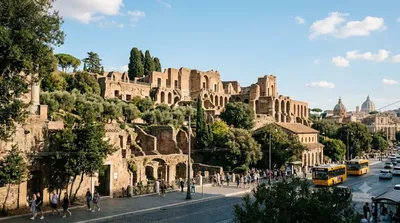
The Palatine Hill, which is the centremost of the seven hills of Rome, is one of the most ancient parts of the city; it has been called "the first nucleus of the Roman Empire". The site is now mainly a large open-air museum and the Palatine Museum houses many finds from the excavations here and from other ancient Italian sites.

0.3 km away

Temple of Vesta

Temples & religious sites

Temple of Vesta

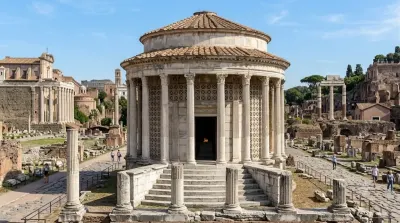
The Temple of Vesta, or the aedes, was an ancient edifice in Rome, Italy. It is located in the Roman Forum near the Regia and the House of the Vestal Virgins. The Temple of Vesta housed Vesta's holy fire, which was a symbol of Rome's safety and prosperity. The temple has a circular footprint, making it a tholos.

0.4 km away

Domus Aurea

Museums & galleries

Domus Aurea

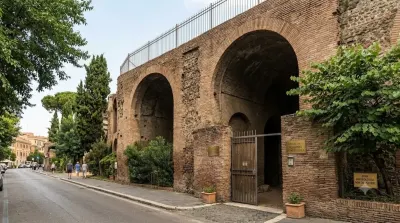
The Domus Aurea was a vast landscaped complex built by the Emperor Nero largely on the Oppian Hill in the heart of ancient Rome after the great fire in 64 AD had destroyed a large part of the city.

0.4 km away

San Pietro in Vincoli

Temples & religious sites

San Pietro in Vincoli

San Pietro in Vincoli is a Roman Catholic titular church and minor basilica in Rome, Italy. The church is on the Oppian Hill near Cavour metro station, a short distance from the Colosseum. The name alludes to the Biblical story of the Liberation of Peter.

0.5 km away

Roman Forum

Parks & gardens

Roman Forum

The Roman Forum, also known by its Latin name Forum Romanum, is a rectangular forum (plaza) surrounded by the ruins of several important ancient government buildings at the centre of the city of Rome. Citizens of the ancient city referred to this space, originally a marketplace, as the Forum Magnum, or simply the Forum.

0.5 km away