World by City

Temples & religious sites

Basilica of Saint Paul outside the Walls
Basilica of Saint Paul outside the Walls

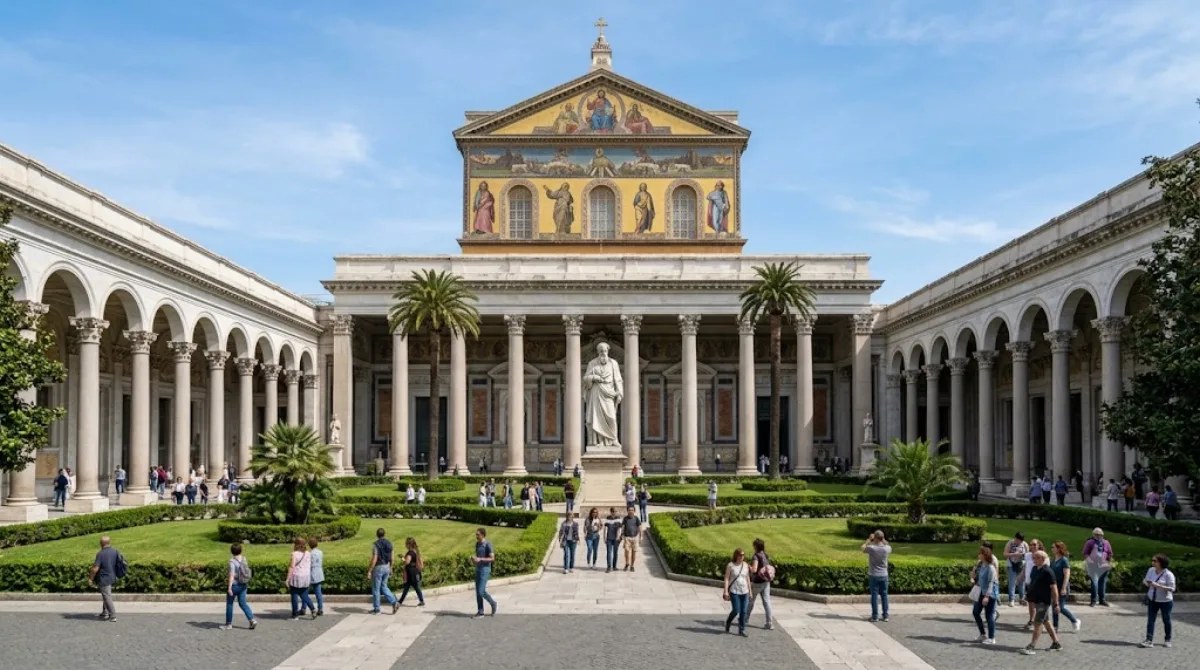
The Papal Basilica of Saint Paul Outside the Walls is one of Rome's four major papal basilicas, along with the basilicas of Saint John in the Lateran, Saint Peter's, and Saint Mary Major, as well as one of the city's Seven Pilgrim Churches. The basilica is the conventual church of the adjacent Benedictine abbey. It lies within Italian territory, but the Holy See owns the basilica and it is part of the Vatican's extraterritoriality.

Basilica of Saint Paul Outside the Walls

This is one of Rome's four papal basilicas, built over the traditional burial site of Saint Paul. Travellers come for the scale of the interior, the mosaic portraits of every pope running around the nave, the gilded ceiling, and the tranquil cloister attached to the working Benedictine abbey. Unlike Rome's more central churches, it sits apart from the usual sightseeing routes, which gives it a calmer, less commercial feel.

Getting there

The basilica is south of the historic centre, outside the old city walls (hence the name). It's reachable by metro on Line B, with a station named after the basilica a short walk from the entrance. From central Rome, expect around 20-25 minutes by metro, or longer by bus or on foot given the distance.

How much time to allow

Plan for roughly 45 minutes to an hour to see the nave, mosaics, and cloister at a reasonable pace. Add more time if you want to sit quietly or explore the cloister garden in detail.

When to go

Mornings tend to be quieter, especially compared to Rome's central basilicas. It draws fewer crowds overall than Saint Peter's, so pressure on timing is lower, but tour groups do pass through, so early visits still help if you want the space to yourself.

Combine it with

Because it's outside the centre, it doesn't pair naturally with a single walking loop. The Baths of Caracalla (2.7km) and Circus Maximus (3.1km) are the closest sights and can be combined with some transit or a longer walk, while Trastevere (3.3km) and the Cloaca Maxima (3.4km) make sense as part of a broader day covering the area between the basilica and the centre.

Sources: open data from Wikipedia and OpenStreetMap · Updated August 5, 2026 · Edited by the World by City editors

Tickets & tours

Admission prices and opening hours change often, so we don't list them here. Check what's on sale and at what price below — booking ahead can cut the queue at some places.

This place may not appear in the results — some sites are free to enter or sell tickets only at the gate.

Stays near Basilica of Saint Paul outside the Walls

Sorted by distance, walkable ones first. Distances are straight-line.

Map © OpenStreetMap contributors. Lines are straight connections, not actual routes.

Basilica of Saint Paul outside the Walls Nearby stays

Locations and names come from OpenStreetMap. Check prices and availability on the booking sites.

Good to visit alongside

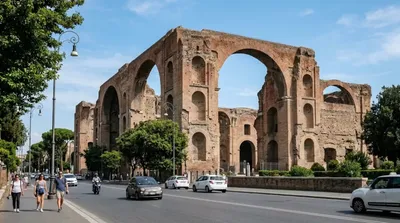
Baths of Caracalla

Museums & galleries

Baths of Caracalla

The Baths of Caracalla in Rome, Italy, were the city's second largest Roman public bath complex, or thermae, after the Baths of Diocletian. The baths were likely built between AD 212 and 216/217, during the reigns of emperors Septimius Severus and Caracalla. They were in operation until the 530s and then fell into disuse and ruin.

2.7 km away

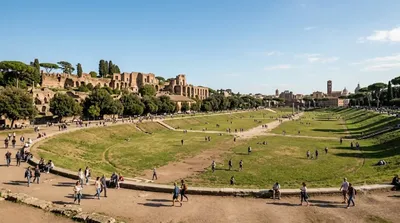
Circus Maximus

Heritage & monuments

Circus Maximus

The Circus Maximus is an ancient Roman chariot-racing stadium and mass entertainment venue in Rome, Italy. In the valley between the Aventine and Palatine hills, it was the first and largest stadium in ancient Rome and its later Empire. It measured 621 m (2,037 ft) in length and 118 m (387 ft) in width and could accommodate over 150,000 spectators. In its fully developed form, it became the model for circuses throughout the Roman Empire. The site is now a public park.

3.1 km away

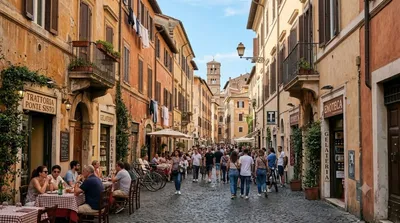
Trastevere

Shopping & districts

Trastevere

Trastevere is the 13th rione of Rome, Italy. It is identified by the initials R. XIII and it is located within Municipio I. Its name comes from Latin trans Tiberim.

3.3 km away

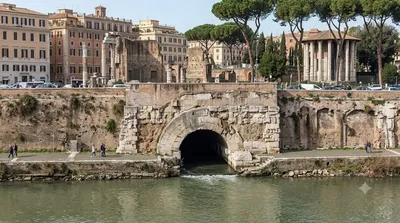
Cloaca Maxima

Heritage & monuments

Cloaca Maxima

The Cloaca Maxima or, less often, Maxima Cloaca, is one of the world's earliest sewage systems. Its name is related to that of Cloacina, a Roman goddess. Built during either the Roman Kingdom or early Roman Republic, it was constructed in Ancient Rome in order to drain local marshes and remove waste from the city. It carried effluent to the River Tiber, which ran beside the city. The sewer started at the Forum Augustum and ended at the Ponte Rotto and Ponte Palatino. It began as an open air canal, but it developed into a much larger sewer over the course of time. Agrippa renovated and reconstr...

3.4 km away

Palatine Hill

Museums & galleries

Palatine Hill

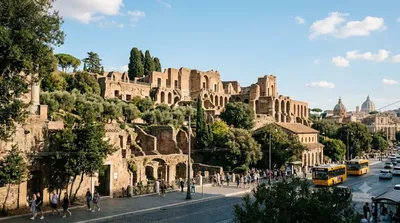
The Palatine Hill, which is the centremost of the seven hills of Rome, is one of the most ancient parts of the city; it has been called "the first nucleus of the Roman Empire". The site is now mainly a large open-air museum and the Palatine Museum houses many finds from the excavations here and from other ancient Italian sites.

3.4 km away

Arch of Constantine

Heritage & monuments

Arch of Constantine

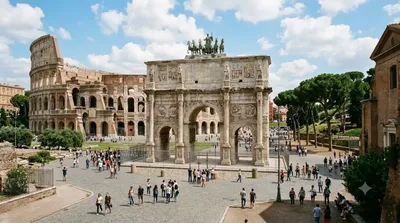
The Arch of Constantine is a triumphal arch in Rome dedicated to the emperor Constantine the Great. The arch was commissioned by the Roman Senate to commemorate Constantine's victory over Maxentius at the Battle of the Milvian Bridge in AD 312. Situated between the Colosseum and the Palatine Hill, the arch spans the Via Triumphalis, the route taken by victorious military leaders when they entered the city in a triumphal procession. Dedicated in 315, it is the largest Roman triumphal arch, with overall dimensions of 21 m (69 ft) high, 25.9 m (85 ft) wide and 7.4 m (24 ft) deep. It has three bay...

3.6 km away