
Kyoto · Central & near stations
Where Should You Stay in Kyoto to Be Close to Stations and Trains?
August 2, 2026 · last updated · about 4 min read
Choosing a Central, Station-Friendly Base in Kyoto
Kyoto's subway is limited to one north-south line (Karasuma) and one east-west line (Tozai), crossing once at Karasuma-Oike. Most temples sit outside this grid, so "central" should mean close to a hub that combines subway, JR, and private rail lines, not just subway proximity.
Kyoto Station area
This is the single best-connected base: JR lines, the Karasuma subway line, and the city's busiest bus terminal all meet here, plus the Haruka airport express from KIX. It suits first-time visitors and anyone making day trips outside the city, though the immediate area is commercial rather than atmospheric.
Karasuma-Oike / Shijo-Karasuma
Sitting on both subway lines, this business district gives quick reach north toward Kyoto Imperial Palace and south to the station, plus walking access to Nishiki Market and downtown shopping. It fits travelers who want a quiet, efficient base without river or old-town character.
Kawaramachi / Gion-Shijo
Served by the Hankyu and Keihan private lines rather than the subway, this area sits closest to Gion, Yasaka Shrine, and the Kamo riverside, with bus routes fanning out to Higashiyama temples. It suits travelers prioritizing atmosphere and nightlife over subway convenience.
What to check before booking
- Confirm the nearest station and which line it serves — subway, JR, or a private line — since they are not interchangeable for reaching temples.
- Check walking distance to a bus stop, as buses cover most temple routes the subway misses.
- If arriving via KIX, confirm proximity to a Haruka stop or direct bus to reduce transfers with luggage.
When to visit and availability
Cherry blossom season (late March–early April) and autumn foliage (November) bring the tightest availability and the highest bus and train congestion, so booking well ahead matters most for these periods. Midsummer and midwinter typically offer more flexibility and calmer transit.
Pick your dates — we'll search Kyoto hotels for you
Choose dates and guests, and the buttons below will open search results with your criteria. Prices differ between sites, so compare before you book.
 View on Booking.com
 View on Hotels.com
Things to see in Kyoto
See all →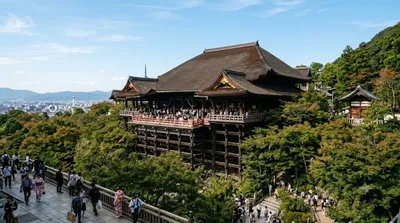
Temples & religious sites
Kiyomizu-dera Temple
Kiyomizu-dera is a Buddhist temple at the foot of the mountains in eastern Kyoto, formally known as Otowasan Kiyomizu-dera. It is the head temple of the Kita Hosso sect of Japanese Buddhism, its principal image is the eleven-headed Kannon, and it is the 16th temple on the Saikoku 33 Kannon Pilgrimage.
Temples & religious sites
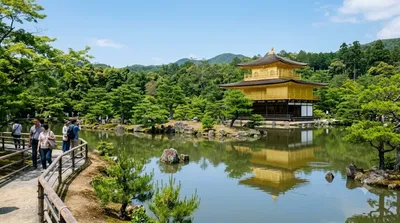
Kinkaku-ji Temple
Kinkaku-ji, formally known as Rokuon-ji, is a Rinzai Zen temple whose symbol is the three-story reliquary hall (Shariden) seen across the pond, Kyoko-chi. Its top two floors are covered in gold leaf, which is why it's more commonly called the "Golden Pavilion." The current building is a 1955 reconstruction, and visitors view it and the surrounding garden while walking the path along the pond rather than entering it.
Temples & religious sites
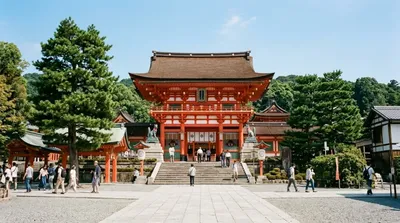
Fushimi Inari-taisha
Fushimi Inari Taisha is the head shrine of all Inari shrines across Japan, located at the foot of Mount Inari. The main draw is the Senbon Torii, thousands of vermilion torii gates forming a tunnel along the path that winds up to the summit.
Nature
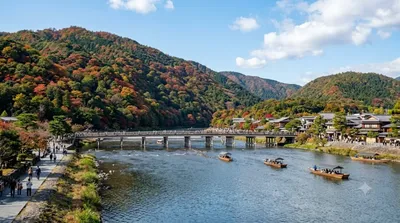
Arashiyama
Arashiyama is a district on Kyoto's western outskirts, set against the mountains rising beyond the Oi River. Designated a national historic and scenic site, it offers a walkable landscape combining riverside views, a bamboo grove path, and nearby temples.
More Kyoto guides
Best value
Where should I stay in Kyoto for the best value near the subway?
5-star & luxury
Where should you stay in Kyoto for a 5-star or luxury trip?
Pool villas & resorts
Where should you stay in Kyoto for a pool villa or resort-style stay?
Family travel
Where to Stay in Kyoto with Kids Around Just Two Subway Lines
Couples & honeymoon
Where should couples stay in Kyoto for a honeymoon trip?
Best time to visit
When Is the Best Time to Visit Kyoto?
First-time guide
How should first-time visitors plan a trip to Kyoto, Japan?
Getting around
How do you get around Kyoto's temples without a car?
Central & near stations guides for other destinations
Guantánamo
Where to stay in Guantánamo for central sights and transport connections
Cetinje
Where to stay in Cetinje for central sights and bus connections
North Nicosia
Where to Stay in North Nicosia for Transit and Central Sights
Cienfuegos
Where to Stay in Cienfuegos Near the Bus Station and City Center